
6 Best Water Filter for Coliform Bacteria for Home Use
The iSpring UVF55FS Whole House UV Water Filter is the best water filter for coliform bacteria for most buyers. Its main advantage is whole-house ultraviolet treatment, which disinfects incoming water at the main line instead of treating only one faucet. That makes it a strong fit for homes needing coliform control throughout the plumbing system. It is a UV purifier, not a sediment or chemical filter, so its role is focused and clear.
This guide is for homeowners dealing with bacterial concerns across multiple fixtures. The most important factors are rated flow capacity, UV dose, chamber size, and lamp maintenance. A system that cannot handle your household’s peak demand may leave some water untreated. The 6 picks below are ranked with reasons and honest drawbacks for each, including whole-house units and smaller point-of-use options.
Quick Comparison
| # | Product | Best For | Price | |
|---|---|---|---|---|
| 1 | iSpring UVF55FS Whole House UV Water Filter | Large-Home UV Treatment | $304.20 | View → |
| 2 | Safe Home DIY Water Bacteria Test Kit | First-Time Water Quality Checkers | $14.99 | View → |
| 3 | Survivor Filter Ultra Gravity Water Filter Replacement Pack | Gravity Filter Backup Stock | $77.95 | View → |
| 4 | HQUA TWS-12 Ultraviolet Water Purifier | Compact UV Purifier Owners | $259.99 | View → |
| 5 | Express Water ROALKUV10D RO Water Filter System | Reverse Osmosis UV Users | $249.99 | View → |
| 6 | DIY Bacteria Water Test Kit, 2-Pack | Multi-Source Bacteria Testing Households | $9.95 | View → |
6 Top Filters for Coliform Bacteria
This ranked list counts down to the top pick, comparing filtration methods, maintenance needs, and water safety features.
6. DIY Bacteria Water Test Kit, 2-Pack

Best for: Homeowners checking private well water
This two-test home kit screens freshwater for coliform bacteria, including E. coli. It works with well, tap, pool, pond, lake, and drinking water samples. Add the water, shake the container, and follow the included instructions. Results develop in about 24 to 48 hours. A yellow color signals a positive result that needs follow-up.
The built-in positive control is the main feature that sets this kit apart. Use one test as the reference control and the second on your water sample. That setup helps confirm the test reacted as expected, instead of leaving you to question a single result. At around $10, it offers a low-cost first check without mailing a sample to a lab. Customer support from PhD scientists is also available through the contact details inside the kit. Still, this is a screening tool, not a full water-quality analysis.
Pros
- Two-pack design includes a separate positive control for checking test performance.
- Tests several freshwater sources, including wells, taps, pools, ponds, and lakes.
- Color-based results appear within roughly 24 to 48 hours, with no special equipment required.
Cons
- A yellow result indicates coliform presence but does not measure bacteria levels or confirm a specific species.
- The test requires up to two days for results, and a positive finding should receive professional laboratory follow-up.
5. Express Water ROALKUV10D RO Water Filter System

Best for: Households wanting mineralized RO water
The Express Water ROALKUV10D is an under-sink reverse osmosis system with 11 filtration stages. It combines standard RO filtration with alkaline mineral treatment and ultraviolet purification. The RO portion is rated to remove up to 99.99% of substances such as lead, chlorine, fluoride, nitrates, calcium, arsenic, bacteria, and other contaminants. Its automatic tank refill means you do not need to refill a separate pitcher or countertop reservoir.
The alkaline stage returns calcium, potassium, magnesium, and other minerals to the filtered water. A UV chamber targets microorganisms, including coliform, E. coli, viruses, and bacteria. The built-in leak detector can stop water flow when it senses moisture, which adds protection beneath the sink. At around $250, this system costs more than basic RO units, but it covers several treatment steps in one setup. Express Water includes a one-year warranty. Still, the listing does not provide tank capacity, filter-change intervals, water-production speed, or cabinet dimensions. Those details matter before installation, especially in a small kitchen.
Pros
- 11 filtration stages combine RO, alkaline mineral treatment, and UV purification.
- UV treatment targets bacteria, viruses, E. coli, and coliform microorganisms.
- A leak detector can shut off water flow when it senses moisture.
Cons
- The system needs enough under-sink space for its tank and multiple filter stages.
- Replacement costs and filter-change schedules are not provided, making long-term upkeep harder to estimate.
4. HQUA TWS-12 Ultraviolet Water Purifier

Best for: Whole-house homes with clear water
The HQUA-TWS-12 is a UV water purifier for whole-house plumbing. It treats up to 12 gallons per minute with a 55-watt ultraviolet lamp and runs from a 120-volt outlet. The chamber measures 21 inches long and 3.5 inches wide, with 3/4-inch MNPT inlet and outlet connections. Its shorter design can fit more easily beside existing pipework than larger housings. It costs around $260.
The lamp is rated for 9,000 hours, and UV treatment does not add chemicals or alter water taste, odor, pH, conductivity, or general chemistry. The package includes one replacement lamp and one quartz sleeve, which lowers the cost of the first service interval. A printed manual covers setup, maintenance, and troubleshooting. UV treatment reduces microorganisms, but it does not remove sediment, metals, or dissolved chemicals. Clear, prefiltered water is needed for proper exposure.
Pros
- 12 GPM capacity suits many whole-house water lines.
- Replacement lamp and quartz sleeve provide useful backup parts.
- Compact 21-inch chamber makes installation easier in tight utility spaces.
Cons
- UV does not filter chemicals, sediment, or heavy metals, so additional filtration may be necessary.
- The 3/4-inch connections and 12 GPM rating may not match larger plumbing systems or high peak demand.
3. Survivor Filter Ultra Gravity Water Filter Replacement Pack

Best for: Big Berkey owners needing replacements
The Survivor Filter Ultra Gravity replacement pack includes two ceramic filters for compatible Big Berkey systems. It is designed for gravity-fed filtration, with no pump or power connection required. The manufacturer says the ceramic media removes bacteria, viruses, parasites, metals, and chemicals from tap water and freshwater. Installation should be straightforward if the replacement filters match your existing fittings.
The main appeal is the combination of broad contaminant claims and mineral retention. Unlike systems that strip minerals from water, these filters are intended to leave essential minerals behind. The filters are also described as third-party tested and certified, though the product information does not name the testing lab or provide detailed performance reports. At around $78, this two-filter pack costs more upfront than basic replacement cartridges. A lifetime manufacturer warranty covers manufacturing and other defects, but it does not necessarily cover normal filter wear or clogging.
Pros
- Includes two ceramic replacement filters, reducing the need for an immediate second purchase.
- Designed to address bacteria, viruses, parasites, metals, and chemicals.
- Retains essential minerals instead of removing them during filtration.
Cons
- The listing does not provide filter capacity, replacement intervals, or filtration speed.
- Third-party testing is claimed, but the available details do not identify the certifier or show test results.
2. Safe Home DIY Water Bacteria Test Kit

Best for: Homeowners checking private freshwater supplies
Safe Home’s DIY water test kit is made for a basic coliform screening at home. It is designed for freshwater sources such as wells, ponds, and other supplies. The kit claims to detect 50 species of coliform bacteria, including E. coli, at levels as low as one organism. The listing also identifies the product as made in the USA and certified by several laboratories, including Good Housekeeping Labs, American Red Cross, Underwriters Laboratories, and Merck Labs.
The standout feature is its short potential wait time. Results may appear in as little as six hours, though some tests can take up to 72 hours. Incubation conditions and the amount of bacteria in the sample affect that timing. Each kit receives third-party sterilization before packaging, which helps reduce the risk of contamination from the test materials themselves. At around $15 for one test, it offers a lower-cost first check before paying for professional laboratory analysis. Still, a positive result should lead to follow-up testing rather than serve as a complete water safety report.
Pros
- Screens for 50 coliform species, including E. coli.
- May show a positive result in six hours.
- Third-party sterilization helps limit false positives from contaminated components.
Cons
- Results can take up to 72 hours under some conditions.
- One kit provides screening, not a full laboratory analysis for all possible contaminants.
1. iSpring UVF55FS Whole House UV Water Filter
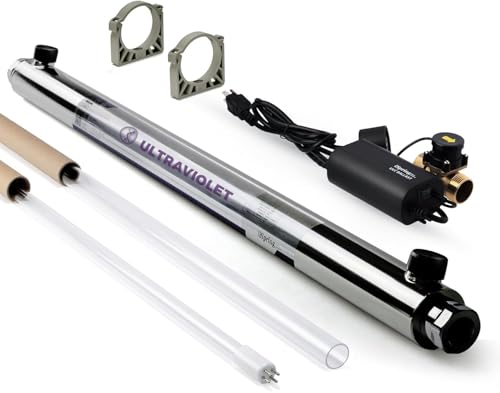
Best for: Whole-house well water disinfection
The iSpring UVF55FS is a point-of-entry UV stage for a whole-house filtration setup. It uses a 55-watt lamp inside a 37.5-inch, 304 stainless steel reactor chamber. The 1-inch MNPT inlet and outlet support flow rates up to 12 gallons per minute, with little pressure loss. At around $304, it costs more than compact point-of-use UV units, but it treats water for every connected fixture.
Its upgraded ballast includes a flow sensor with Auto, Move, and Stop modes. In Auto mode, the lamp activates when flow reaches 0.66 gallons per minute, which can reduce unnecessary runtime. The quartz-sleeved bulb has a rated life of up to 9,000 hours, though the lamp still needs yearly replacement. Mounting clips support DIY installation, but the unit needs power and proper plumbing. It should sit after sediment and other filtration, since UV light does not remove dirt, chemicals, metals, or dissolved minerals. Cleaning the quartz sleeve every 6 to 12 months also helps maintain light transmission.
Pros
- Treats water at the main line, including faucets, showers, and appliances.
- The flow sensor limits lamp operation when water is not moving.
- A 304 stainless steel chamber and quartz sleeve support long-term use.
Cons
- Annual lamp replacement and sleeve cleaning add maintenance costs and work.
- UV treatment does not remove sediment, chlorine, chemicals, or heavy metals, so upstream filters may be necessary.
Buying Guide
Most important factor is verified bacteria reduction, not a small micron rating alone. Look for NSF/ANSI 55 Class A UV certification or a filter specifically certified to reduce coliform bacteria, because many taste and sediment cartridges do not remove microbes.
- Bacteria certification: Choose a model with NSF/ANSI 55 Class A or an explicit coliform-reduction claim from an independent certifier. A 0.2-micron absolute rating is more meaningful than “submicron” alone.
- Flow rate: Match output to demand. A countertop unit producing 0.5-1 gallon per minute suits drinking water, while a whole-house system may need 8-12 gallons per minute.
- UV treatment needs: UV systems require clear water and electricity. Add a 5-micron sediment prefilter, and choose at least 40 mJ/cm² UV dose for contaminated water.
- Replacement schedule: Price cartridges or lamps before buying. Sediment filters often last 3-6 months, while UV lamps commonly need annual replacement, even if they still light up.
- Water testing: Test for total coliform and E. coli before and after installation. A certified laboratory test often costs $20-$50, and private wells should be retested after repairs or flooding.
If money or space is limited, prioritize independently verified coliform reduction over flow rate or appearance.
Frequently Asked Questions
How do I choose a water filter for coliform bacteria?
Choose a microbiological water filter certified to remove bacteria, and add disinfection when testing shows it is needed. Look for NSF P231 certification or verified pore-size performance, then retest the water after installation. A 0.2-micron rating alone is not enough unless the manufacturer confirms bacterial removal.
What should I look for in a home water filter for coliforms?
A filter rated for bacteria removal, not only chlorine or sediment, is the right type for coliforms. Check the label for NSF P231 certification or independent bacteria-removal data. If test results show contamination, use bottled or boiled water until treatment is confirmed.
Can a pitcher filter remove coliform bacteria?
Yes, a pitcher filter can reduce coliform bacteria only when its documentation specifically claims bacterial removal and the unit stays within its rated capacity. Many common pitchers target taste, odor, and chlorine instead. Replace cartridges on the stated schedule, which may be every 2 to 6 months.
Are UV water purifiers effective against coliform bacteria?
Yes, UV purifiers can inactivate coliform bacteria when the lamp receives power and the water is clear enough for the dose to work. They do not remove sediment or chemicals. A prefilter may be needed, and many lamps require replacement after about 9,000 operating hours.
Conclusion
The iSpring UVF55FS Whole House UV Water Filter is the strongest fit for households that want one treatment point for bacteria across multiple taps. If your priority is lower upfront cost and drinking-water-only coverage, choose a certified under-sink system instead, since it avoids treating every outlet. Before buying, double-check the unit’s size, plumbing compatibility, replacement-lamp quantity, and current price, because installation parts and recurring maintenance can change the total cost. UV treatment also works best with clear water, so check whether prefiltration is required for your source. For a private well, test for coliform bacteria first and address the cause, not just the symptom. A filter can reduce exposure, but it cannot fix a contaminated well.