
5 Best Backpack Solar Charger Picks for Hiking
For most buyers, the BLAVOR Solar Power Bank Wireless Charger is the best backpack solar charger. Its main strength is flexibility: it combines a portable battery, wireless charging, and solar charging in one rugged unit. That setup suits day hikes, travel, and emergency kits, though solar input works better for topping up than quickly refilling the whole battery.
This guide is for hikers, campers, travelers, and anyone who needs backup power away from outlets. The key factors are battery capacity, overall weight, panel performance, and protection from rain or drops. A larger battery can charge more devices, but it also adds bulk to a backpack. The five picks below are ranked by their practical strengths, with clear reasons and honest drawbacks for each.
Quick Comparison
| # | Product | Best For | Price | |
|---|---|---|---|---|
| 1 | BLAVOR Solar Power Bank Wireless Charger | Backpackers needing wireless backup | $29.99 | View → |
| 2 | BigBlue Solar Panel Charger | Campers with larger devices | $59.97 | View → |
| 3 | SOLUPUP 30W Portable Solar Charger | Multi-device travelers needing faster charging | $35.19 | View → |
| 4 | BLAVOR Solar Power Bank | Emergency kits needing compact power | $29.99 | View → |
| 5 | BLASOUL Solar Power Bank, Wireless Portable Charger | Phone users avoiding charging cables | $39.99 | View → |
5 Top Solar Chargers for Backpacks
These ranked picks count down to the top choice, with portability, charging options, durability, and price guiding the order.
5. BLASOUL Solar Power Bank, Wireless Portable Charger

Best for: Campers needing backup power
The BLASOUL Solar Power Bank is a high-capacity battery pack with a 49,800mAh lithium-polymer battery. It includes three built-in output cables for iOS, USB-C, and Micro USB, plus a USB-A input cable. That setup cuts down on loose accessories in a day bag. The USB-C cable supports up to 20W when used alone, while the main output reaches 22.5W through PD 3.0 and QC 3.0. BLASOUL lists enough output to charge an iPhone 14 to 60% in about 30 minutes, using a compatible setup.
Wireless charging reaches 15W for supported phones, including newer iPhone and Samsung Galaxy models. A built-in light offers steady, SOS, and strobe modes. The IP65 rating adds protection from dust and water spray, but this charger is not designed for submersion. It can recharge from a wall adapter or sunlight, though solar charging works best as an emergency supplement. At around $40, it offers many charging options in one unit, but buyers should check its size and weight before packing it for long hikes.
Pros
- Four built-in cables reduce the need to pack separate charging cords.
- 22.5W wired output and 15W wireless charging support quick top-ups.
- IP65 protection and a three-mode flashlight suit outdoor emergencies.
Cons
- Solar recharging is likely slow and depends heavily on direct sunlight.
- Wireless charging requires a compatible phone and proper placement.
4. BLAVOR Solar Power Bank

Best for: Hikers needing backup power
The BLAVOR 10,000mAh power bank combines portable charging with outdoor safety features. It sells for around $30 and supports USB-C, wireless charging, and other output methods. Its USB-C port reaches 20W, with a claimed iPhone 15 charge to 65% in 30 minutes. You can charge up to three devices at once, including iPhones, iPads, and Samsung phones.
The battery uses lithium-cobalt cells, which BLAVOR rates for 50% more cycles than standard lithium-polymer cells. A full charge is rated for about 3.6 iPhone 8 charges, 2.2 iPhone 14 Pro charges, or one iPad Air charge. Its case uses flame-retardant ABS and PC plastic, with a silicone outer layer for added protection. The IPX5 rating handles water spray, while two bright flashlights, a compass, and a carabiner add useful trail gear. Solar charging works as an emergency top-up, but it is not a fast replacement for wall charging.
Pros
- 20W USB-C output can quickly recharge compatible phones.
- Wireless charging and multiple ports support up to three devices.
- Flashlights, compass, carabiner, and shock-resistant construction suit outdoor use.
Cons
- Solar charging depends on strong sunlight and works slowly.
- IPX5 protection resists water spray, not submersion in water.
3. SOLUPUP 30W Portable Solar Charger

Best for: Hikers needing daytime USB power
The SOLUPUP is a foldable 30W solar charger for phones, tablets, and power banks. Its monocrystalline silicon cells claim more than 23% energy conversion efficiency, though real output depends on sunlight, temperature, angle, and cloud cover. It provides one USB-A port and one USB-C port, each rated for 5V/3A, with a combined maximum output of 15W. That makes it useful for topping up small devices at a campsite, but it is not a replacement for a full power station.
This panel weighs 2.4 pounds and folds to about 10.63 inches for backpack storage. Two carabiners let you attach it to a pack, while the built-in stand supports a stationary setup. A smart chip helps manage overcurrent, overvoltage, and short-circuit risks. It can reconnect after sunlight returns, which helps during passing clouds. The IPX5 rating protects against rain and water spray, not submersion. Around $35, the package includes a USB-to-USB-C cable, two carabiners, and a manual.
Pros
- Dual USB-A and USB-C ports can charge two devices at once under strong sunlight.
- Monocrystalline cells offer a stated conversion efficiency above 23%.
- The 2.4-pound foldable design includes carabiners and a built-in stand.
Cons
- The 30W panel has a 15W maximum USB output, so charging larger devices can take time.
- Cloud cover, heat, poor positioning, and weak sunlight can reduce charging considerably.
2. BigBlue Solar Panel Charger

Best for: emergency kits and sunny hikes
BigBlue’s 28W foldable solar charger is built for direct device charging outdoors. It folds to 11 x 6 x 1.4 inches and weighs 1.5 pounds, so it can fit in a small backpack or preparedness kit. The panel uses N-type solar cells and a polymer surface rated IP44 for the panel section. It does not contain a battery, so it cannot save power for later.
Three ports give this charger useful flexibility: two USB-C ports and one USB-A port. Each is rated up to 5V/3A, with a combined maximum of 5V/4.8A. That setup can charge several smaller devices at once, though sunlight, panel angle, heat, and device limits affect actual output. The panel claims 25.4% sunlight conversion and improved low-light performance, but cloudy conditions can still reduce or interrupt charging. The package includes a 50cm USB-C cable and carabiners. The USB junction box is not waterproof, and an Apple charging cable is not included. Keep phones shaded to avoid heat-related slowdowns.
Pros
- Three USB ports support charging multiple small devices at once.
- Folded dimensions and 1.5-pound weight suit hiking packs and emergency storage.
- N-type cells and a polymer surface support low-light use and outdoor durability.
Cons
- It cannot store electricity, so devices must stay connected in direct sunlight.
- Output is not suitable for laptops or large power stations, and the junction box lacks waterproofing.
1. BLAVOR Solar Power Bank Wireless Charger
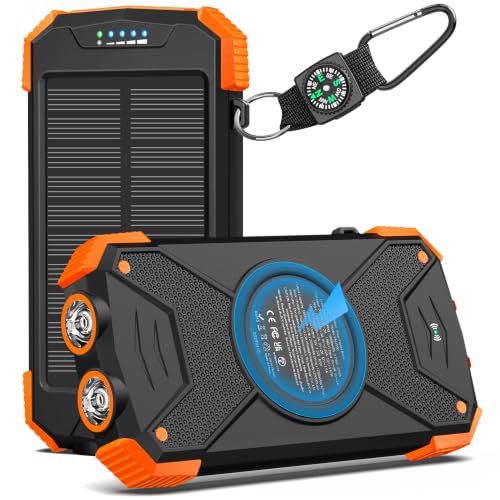
Best for: Campers needing backup power
The BLAVOR Solar Power Bank packs a 10,000mAh battery into a compact outdoor charger. It supports USB-C input and output, with up to 20W wired charging. BLAVOR claims it can bring an iPhone 15 to 65% in 30 minutes. It can also charge three devices at once through wired and wireless connections. The battery is rated for about 3.6 iPhone 8 charges, 2.2 iPhone 14 Pro charges, or one iPad Air charge.
Its lithium-cobalt battery is rated for 50% more cycles than a standard lithium-polymer cell. The case combines flame-retardant ABS and PC plastic with a silicone waterproof layer. An IPX5 rating protects against water spray, while shock and dust resistance suit camping trips. Two bright flashlights, a compass, and a carabiner add practical value around camp. At around $30, it offers more utility than a basic battery pack, though its solar feature has limits.
Pros
- 20W USB-C output supports faster charging for compatible phones.
- Wireless charging and multiple ports can power three devices together.
- Flashlights, compass, carabiner, and IPX5 protection fit outdoor use.
Cons
- Solar charging depends on strong sunlight and works slowly compared with USB-C.
- IPX5 protects against water spray, not submersion or heavy water exposure.
Buying Guide
The most important factor is usable charging output, not panel size. A 5-watt panel may only provide emergency power in strong sunlight, while a 10-watt or larger panel can recharge devices more effectively during a full day outdoors.
- Solar panel wattage: Choose at least 5 watts for emergency phone charging, or 10 to 15 watts for regular outdoor use. Expect slower charging in shade, winter, and cloudy weather.
- Battery capacity: A built-in 10,000mAh battery can usually provide about one to two phone charges. Look for 20,000mAh if you need several charges between outlets.
- Pack size and comfort: Pick 15 to 25 liters for daily carry, or 30 liters or more for camping gear. Padded shoulder straps and a chest strap help with heavier loads.
- Ports and charging speed: Look for USB-C input and output, plus at least one USB-A port. USB-C Power Delivery of 18 watts or higher can charge compatible phones faster.
- Weather protection and price: Water-resistant fabric and covered zippers help during light rain, but they do not make the pack waterproof. Expect to pay about $60 to $180 for a backpack with a panel and battery.
If you cannot have everything, prioritize panel output and battery capacity over extra pockets or decorative features.
Frequently Asked Questions
How does a backpack solar charger work?
A backpack solar charger uses photovoltaic panels to turn sunlight into electricity for a phone, battery pack, or other USB device. Most models store power in an internal battery, then charge devices later. Output varies with sun, panel size, and shadows, so direct charging often takes several hours.
What features should I look for in a solar backpack charger?
The best features in a backpack solar charger are a reliable battery, USB-C output, weather-resistant construction, and a panel large enough for your needs. Check capacity in milliamp-hours and output in watts. A 10,000mAh battery and 10W panel suit basic phone charging, not laptops.
Can a solar backpack charger charge a phone on cloudy days?
Yes, a solar backpack charger can charge a phone on cloudy days, but it will charge more slowly and may produce too little power under heavy cloud. Thin cloud can still provide usable energy, while dense cloud may reduce charging speed sharply. A backup battery helps on poor-weather trips.
Are solar backpack chargers worth it for hiking?
Solar backpack chargers are worth it for hikers who spend multiple days away from outlets, but they are less useful for short trips or shaded routes. A 10,000mAh battery can provide roughly one to two phone charges, while its panel may need several hours of strong sunlight to refill.
Conclusion
The top recommendation is the BLAVOR Solar Power Bank Wireless Charger, a strong fit for hikers who want one compact backup battery with wireless charging for compatible phones. If your priority is collecting more sunlight during longer trips, choose a larger foldable panel instead, since its broader surface can suit campsite charging better than a small backpack-ready unit. Before buying, double-check the charger’s size, phone and case compatibility, included quantity, and current price, since listings and bundles can change. Also consider where it will ride on your pack and how often you can expose it to direct sun. A good choice should match your daily power needs, not just its advertised charging features.