
6 Best Energy Efficient Electric Tankless Water Heater RVs
The 110V Electric Tankless Water Heater is the best energy efficient electric tankless water heater for most buyers because it heats water only when needed. This point-of-use design avoids keeping a storage tank hot between uses. It fits sinks, kitchenettes, bathroom basins, and other small outlets where a full-size heater would waste space and energy. Its compact size also suits renters, workshops, cabins, and homes with limited utility-room space. Actual flow still depends on incoming water temperature and available electrical capacity.
This guide is for shoppers who want hot water without a storage tank, especially for single fixtures or small additions. Focus first on wattage and flow rate, since those numbers affect heating speed and usable water temperature. Installation needs also matter, including circuit size, plumbing connections, and freeze protection. The 6 picks below are ranked with clear reasons and honest drawbacks for each, so you can compare fit, cost, and daily practicality before choosing.
Quick Comparison
| # | Product | Best For | Price | |
|---|---|---|---|---|
| 1 | 110V Electric Tankless Water Heater | Small Apartment Hot Water | $55.98 | View → |
| 2 | APUS 27kW Electric Tankless Water Heater | Large Household Demand | $332.49 | View → |
| 3 | ORBEK Electric Tankless Water Heater | Compact Bathroom Installation | $199.49 | View → |
| 4 | Jflapil Tankless Electric Water Heater | Budget-Conscious Homeowners | $57.89 | View → |
| 5 | Rheem RTGH Series Natural Gas Tankless Water Heater | Natural Gas Homeowners | $1,049.99 | View → |
| 6 | Electric Tankless Water Heater | Energy-Saving Water Heating | $169.99 | View → |
6 Top Energy-Saving Tankless Heaters
These energy-saving tankless heaters are ranked from sixth to first, with the top pick last.
6. Electric Tankless Water Heater

Best for: Small homes needing point-of-use hot water
This 11kW electric tankless water heater runs on 240 volts and delivers up to 2.6 gallons per minute. Its compact wall-mounted case measures 9.7 inches wide, 14 inches high, and 3.4 inches deep, so it takes far less room than a storage tank. The 1/2-inch NPT water connections fit common point-of-use installations, such as bathroom sinks, faucets, and small kitchens. At around $170, it offers a lower upfront cost than many larger whole-home systems.
The heater adjusts its power based on water flow and incoming temperature. That helps maintain a steadier output, while the digital control lets you select temperatures from 86°F to 140°F. It can provide hot water within seconds and continues heating while water flows, with no tank waiting period. ETL certification, leakage protection, overheat protection, and dry-fire protection add useful safety measures. A two-year warranty and technical support also provide some ownership coverage. Still, its electrical requirements deserve careful attention before purchase.
Pros
- Delivers up to 2.6 GPM for sinks, faucets, and other point-of-use fixtures.
- Compact 9.7-by-14-by-3.4-inch design saves wall and floor space.
- Self-adjusting power helps control energy use as demand changes.
Cons
- Requires a 50-amp double-pole breaker and 8 AWG wiring with ground.
- The 2.6 GPM output is better suited to point-of-use service than multiple fixtures at once.
5. Rheem RTGH Series Natural Gas Tankless Water Heater
Best for: Large homes with multiple bathrooms
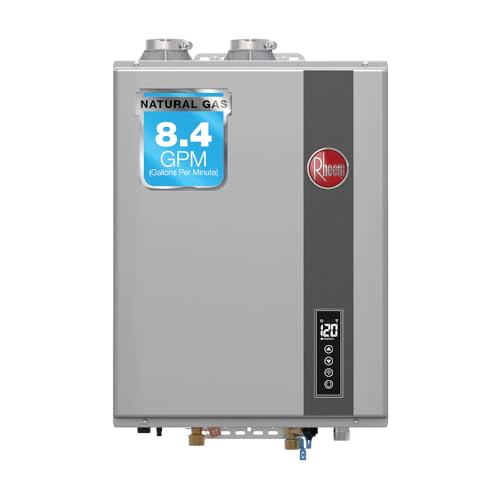
The Rheem RTGH Series is an indoor natural gas tankless water heater for whole-house use. Its 157,000 BTU-per-hour burner delivers a rated 8.4 gallons per minute at a 35°F temperature rise, enough capacity for several fixtures when demand and incoming water conditions match. Because it heats water only as needed, it avoids the standby losses of a storage tank and suits homes that need hot water throughout the day.
Its condensing design reaches a 0.93 Uniform Energy Factor and may use up to 34% less energy than a standard 50-gallon electric tank. Direct venting, ultra-low NOx emissions, and CSA certification support indoor installation, but a qualified installer should handle the gas, vent, condensate, and water connections. A digital control sets temperature within ±1°F. Freeze protection and multiple safety controls add protection. The package includes mounting hardware and a manual. Around $1,050, it costs more upfront than many tank heaters, but the 15-year heat-exchanger and five-year parts warranties add long-term coverage.
Pros
- 8.4 GPM capacity can support several showers and fixtures.
- 0.93 UEF condensing operation can reduce gas use.
- Freeze protection and CSA certification add safety features.
Cons
- Professional installation may require new gas, vent, and condensate connections.
- The 8.4 GPM rating applies at a 35°F rise, and colder incoming water can reduce usable flow.
4. Jflapil Tankless Electric Water Heater

Best for: Point-of-use kitchen sinks
This compact electric water heater is designed for sinks, not full showers. Its 3,000-watt heating element runs on 110 volts and mounts vertically on a wall, leaving cabinet and floor space open. Stainless steel and ABS construction should suit kitchen or utility-room installations. The digital display shows the current temperature and switches between Fahrenheit and Celsius after holding the power button for six seconds.
Temperature control ranges from 82°F at 0.3 gallons per minute to 131°F at 0.5 gallons per minute. That low flow makes it practical for handwashing, rinsing dishes, or other light sink tasks. Safety features include dry-burn protection, overheating protection, water-electric isolation, leakage protection, IPX4 water resistance, and automatic shutoff during idle periods. The unit uses standard 1/2-inch NPT connections and includes pre-drilled mounting holes. At around $58, it offers a relatively low-cost option for adding hot water at one fixture. The manufacturer lists a 24-month warranty and 24/7 online support.
Pros
- Digital temperature display supports both Fahrenheit and Celsius.
- Compact wall-mounted design fits narrow spaces and RV interiors.
- Multiple safety controls include dry-burn and overheating protection.
Cons
- The 0.3 to 0.5 GPM flow range is unsuitable for showers or high-flow faucets.
- Installation requires vertical mounting, at least 2.5 mm² wiring, and a 32A or larger circuit breaker.
3. ORBEK Electric Tankless Water Heater

Best for: Small homes with high electrical capacity
The ORBEK 14kW electric tankless water heater delivers up to 3.38 gallons per minute through a 240V system. It is designed to supply hot water to two or three points of use, such as a bathroom and kitchen, though actual flow depends on incoming water temperature and demand. The unit measures 14.2 inches high, 9.5 inches long, and 3.1 inches wide, making it a practical choice for tight utility spaces. Its temperature range runs from 86°F to 140°F.
The strongest feature is its electronic temperature control. The internal chip adjusts heating output 20,000 times per second, with the manufacturer claiming temperature stability within 1°F. It also reports hot water within three seconds and includes an LED display for live temperature adjustments. Safety features include leakage, over-temperature, dry-heating, and lightning protection. The design separates water and electrical components to help reduce scale and corrosion. At around $200, it costs less upfront than many larger systems, but installation may add substantially to the total.
Pros
- Compact 14.2-by-9.5-by-3.1-inch housing fits narrow installation areas.
- Supplies up to 3.38 GPM for simultaneous bathroom and kitchen use.
- Adjustable 86°F to 140°F display provides precise temperature control.
Cons
- Requires a 150-amp household panel, a 240V 60-amp two-pole breaker, and 6 AWG wiring.
- Maximum flow may drop when groundwater is cold or multiple fixtures run together.
2. APUS 27kW Electric Tankless Water Heater
Best for: Larger homes with multiple bathrooms
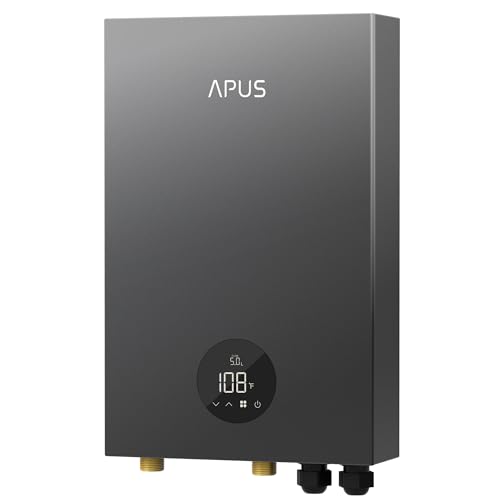
This 27kW electric tankless water heater is designed for permanent 240V residential installation. It can deliver up to 6.5 GPM, which may support three or four uses at once, depending on incoming water temperature, flow, and selected temperature. The wall-mounted unit measures about 17.7 by 11.4 by 3.5 inches, so it takes little floor space in a utility room or basement.
The LED display lets you set the outlet temperature from 86°F to 140°F in 1°F steps. A memory function recalls the last setting, while self-modulation adjusts power as water demand changes. Since there is no storage tank, the heater does not repeatedly warm stored water between uses. Standard 3/4-inch NPT connections simplify plumbing compatibility. Still, this is a demanding electrical installation. It requires three 40A breakers, 6×8 AWG cable, proper grounding, and professional installation.
Pros
- Up to 6.5 GPM can support several fixtures at once.
- 1°F controls provide more precise temperature adjustments.
- Compact 17.7-inch wall-mounted design saves floor space.
Cons
- Actual flow can drop in colder climates or with high demand.
- The electrical setup requires three 40A breakers and specialized wiring.
1. 110V Electric Tankless Water Heater

Best for: Point-of-use kitchen and bathroom sinks
This 3,000W electric tankless water heater is designed for sinks, small apartments, RVs, and camping setups. Its stainless steel and ABS housing measures compactly for wall mounting, while standard 1/2-inch NPT connections support common plumbing setups. The LED display shows operating information and lets you switch between Fahrenheit and Celsius by holding the power button for six seconds. At around $56, it costs less than many larger water-heating systems.
The heater claims to raise water temperature by about 82°F at 0.3 GPM and up to 131°F at 0.5 GPM, with hot water available without a storage tank or preheating period. Safety features include dry-boil protection, overheating and inactivity shutoff, leakage protection, water-electricity isolation, and an IPX4 rating. Installation requires vertical mounting only, Teflon tape on pipe connections, wiring of at least 2.5 square millimeters, and a circuit rated above 32A. A 24-month warranty adds some purchase protection. This unit is not intended for showers, which typically need at least 1.8 GPM.
Pros
- Delivers on-demand hot water without a storage tank or preheating.
- Digital display supports temperature-unit changes and status monitoring.
- Compact wall-mounted design fits under sinks and in RVs.
Cons
- Not suitable for showers because its flow rate is far below the stated 1.8 GPM requirement.
- Installation needs a high-capacity circuit above 32A and proper wiring, which may require an electrician.
Buying Guide
Most important factor is your home’s electrical capacity. A whole-home electric tankless unit may require 80–150 amps at 240 volts, so an undersized panel can make installation costly or impossible.
- Electrical service: Confirm the model’s kilowatt rating and breaker needs. A 24-kilowatt heater typically draws 100 amps at 240 volts and may require two or three 40-amp breakers.
- Flow rate: Match output to simultaneous demand. Choose at least 5–7 gallons per minute for a shower plus a faucet, or 8–11 GPM for two showers.
- Temperature rise: Compare rated flow at your incoming water temperature. In a cold climate, 40°F water heated to 105°F needs a 65°F rise, which reduces maximum flow.
- Energy rating: Look for a Uniform Energy Factor of 0.98 or higher. Electric tankless models also avoid the tank’s constant reheating losses.
- Installation cost: Budget roughly $500–$2,000 for electrical upgrades, wiring, plumbing, and permits, separate from the heater’s purchase price.
If you cannot have everything, prioritize electrical capacity, because the wrong power supply can rule out an otherwise suitable heater.
Frequently Asked Questions
How energy efficient are electric tankless water heaters?
Electric tankless water heaters can be highly efficient because they heat water only when a tap calls for it, instead of storing hot water. Their actual savings depend on usage, local electricity rates, and installation. A unit may draw 12 to 36 kilowatts while operating, so circuit capacity matters.
What size electric tankless heater do I need?
Choose an electric tankless heater by matching its flow rate and temperature rise to your household’s demand. A shower using 2.0 gallons per minute, with 50°F incoming water heated to 105°F, needs roughly 27 kilowatts before losses. Check the breaker panel and manufacturer’s sizing chart.
Can an electric on-demand water heater supply a whole house?
Yes, an electric on-demand heater can supply a whole house, but only when its output and electrical service support simultaneous demand. For example, two showers using 2.0 gallons per minute require 4.0 gpm, before adding sinks or appliances. Homes with limited service may need an electrician to confirm capacity.
Are electric tankless water heaters hard to maintain?
Yes, electric tankless models usually need less routine maintenance than storage tank heaters, but they are not maintenance-free. In hard-water areas, mineral scale can reduce flow and heating performance. Follow the manual’s flushing schedule, which may range from every six months to once yearly.
Conclusion
The 110V Electric Tankless Water Heater is the top recommendation for shoppers who need a compact point-of-use unit for one sink or another low-demand fixture. If your priority is supplying a shower, kitchen, or multiple outlets, choose a higher-voltage model with greater flow capacity instead, since a small 110V heater may not keep up. Before buying, double-check the heater’s size, electrical compatibility, plumbing connections, required quantity for your home, and current price. Pay close attention to circuit requirements and available installation space. These details can affect operating costs and installation difficulty. A careful match helps prevent weak water flow, overloaded circuits, and an expensive return after delivery.