
7 Best Solar Panel Charger for Camping Trips
The LUMOPAL Portable Solar Panel is the best solar panel charger for camping for most buyers because it offers a practical balance of portable charging and everyday versatility. It is designed as a foldable panel for outdoor power banks, phones, and other compatible devices, so it fits trips where wall outlets are limited. Its value comes from flexibility, not from replacing a full power station.
This guide is for campers, hikers, van travelers, and emergency-kit builders who need to recharge small electronics away from the grid. The key factors are panel size, packed weight, charging-port compatibility, and power output in changing sunlight. A compact design is easier to carry, while a larger surface can collect more sunlight but takes more pack space. The 7 picks below are ranked with clear reasons and honest drawbacks for each, so you can choose a charger that matches your route, gear, and weather expectations.
Quick Comparison
| # | Product | Best For | Price | |
|---|---|---|---|---|
| 1 | LUMOPAL Portable Solar Panel | Backpackers needing compact charging | $59.99 | View → |
| 2 | BigBlue Solar Panel Charger | Campers charging multiple devices | $59.97 | View → |
| 3 | FlexSolar Foldable Solar Panel Charger | RV travelers wanting foldable power | $53.98 | View → |
| 4 | VTOMAN VS110 Portable Solar Panel | Van lifers needing higher output | $99.99 | View → |
| 5 | SOARAISE Solar Power Bank | Emergency kit battery backup | $59.99 | View → |
| 6 | SOLPERK Solar Panel Kit | Homeowners mounting a solar setup | — | View → |
| 7 | FlexSolar 100W Portable Solar Panel Charger | Off-grid users needing 100W output | $89.99 | View → |
7 Solar Chargers for Camping Worth Considering
This ranked list compares seven camping solar chargers, counting down from useful options to the strongest overall pick.
7. FlexSolar 100W Portable Solar Panel Charger

Best for: Car campers needing flexible charging
The FlexSolar 100W is a foldable solar panel for camping, RV trips, backup power, and portable power stations. It weighs 4.1 pounds and folds to 12.99 by 10.43 by 2.17 inches, so it fits more easily in a vehicle than a rigid panel. A carry bag comes included. Unfolded, the panel measures 45.47 by 26.18 inches and uses monocrystalline cells with E-Film lamination. Its listed conversion efficiency exceeds 23 percent.
The output selection is useful for mixed gear. You get a 100W DC port, 45W USB-C PD, and 18W USB-A, with support for charging three devices at once. The included cable has DC5521, DC7909, Anderson, and XT60 connectors. That covers many power stations and battery packs without requiring a separate adapter. The panel carries an IP67 rating for water and dust resistance, though its $90 price does not include energy storage. Sun angle, shade, and clouds will also affect actual output.
Pros
- Folds into a compact case and weighs 4.1 pounds, making transport easier.
- Three output types support phones, USB gear, and compatible power stations.
- IP67 protection helps shield the panel from rain, dust, and sand.
Cons
- The 100W rating represents peak sunlight conditions, not constant real-world output.
- It stores no power, so you need a separate battery or power station for use after dark.
6. SOLPERK Solar Panel Kit
Best for: Maintaining 12V vehicle batteries outdoors
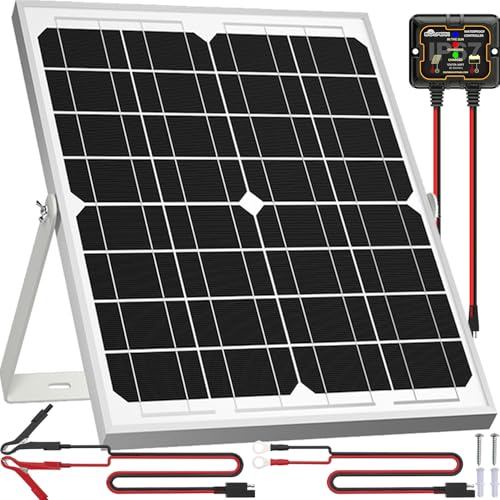
This SOLPERK kit combines a 20W monocrystalline solar panel, an 8A smart MPPT controller, and an adjustable mounting bracket. It is designed to maintain 12V rechargeable batteries used in cars, boats, RVs, motorcycles, tractors, lawn mowers, and similar equipment. The included cables, alligator clips, O-rings, and mounting hardware support several installation options.
The panel uses low-iron tempered glass and a corrosion-resistant aluminum frame. SOLPERK rates its cell efficiency at 21% to 30%, though actual output will vary with sunlight, shade, and panel angle. The bracket rotates through 360 degrees, which helps with seasonal positioning. The company also lists a 25-year panel lifespan, resistance to 2,400Pa wind pressure, and resistance to 5,400Pa snow load. Two controller lights show charging status, while three-stage charging helps reduce overcharging and short-circuit risks. One year of after-sale service and lifetime technical support are included.
Pros
- 20W output can provide a steady maintenance charge for many 12V batteries.
- Tempered glass and an aluminum frame suit outdoor vehicle and marine installations.
- The 360-degree bracket and pre-drilled holes simplify angle adjustment and mounting.
Cons
- A 20W panel charges slowly, so it is not suitable for quickly recovering a deeply drained battery.
- Solar output drops in shade, storms, winter conditions, and poor panel angles.
5. SOARAISE Solar Power Bank

Best for: Multi-device camping and travel
The SOARAISE Solar Power Bank combines a 48,000mAh lithium-polymer battery with four fold-out solar panels. Its 5V/3A USB-C port can charge compatible phones faster than standard 5V/1A outputs. The maker claims charging an iPhone from 15% to 60% takes about 30 minutes through this port. At around $60, it costs more than basic power banks, but offers more connection options.
This charger includes two USB-A outputs, one USB-C input/output, four built-in cables, and a wireless charging pad. The cables cover USB-C, phone, USB-A, and Micro connections, so you can carry fewer loose cords. It is designed to power up to seven devices, though charging several items at once may reduce speed. The wireless pad supports many recent iPhone and Samsung Galaxy models. Four panels may collect more sunlight than a single panel, but actual solar charging still depends on direct sun and weather.
Pros
- 48,000mAh capacity provides extended backup power for trips and outages.
- Four built-in cables, three ports, and wireless charging support varied devices.
- USB-C output reaches 5V/3A for faster compatible phone charging.
Cons
- Solar charging can be slow or ineffective in clouds, shade, and indoors.
- The 5V/3A output is not suited to high-wattage laptop charging.
4. VTOMAN VS110 Portable Solar Panel

Best for: Campers with compatible power stations
The VTOMAN VS110 is a folding 110-watt solar panel for charging portable power stations away from an outlet. It uses monocrystalline silicon cells and a listed 23% conversion rate. Its 19V working voltage supports VTOMAN Jump 600X, Jump 1000, Jump 1500X, and Jump 1800 units. The panel includes MC4 connectors, plus an adapter for Anderson, XT60, and DC5521 inputs. At around $100, it costs less than many larger portable panels.
Two adjustable kickstands make ground setup straightforward, while four circular holes allow hanging from an RV or balcony. Folded, the panel measures 25.6 by 23.7 by 1.4 inches and weighs 12.5 pounds. That size fits car-based camping better than backpacking. The IP67 rating helps protect against splashes, but the instructions say not to leave it in rain or soak it. A two-year warranty adds useful coverage, and the box includes the panel, adapter, and manual.
Pros
- Supports several common power station inputs through MC4, Anderson, XT60, and DC5521 connections.
- Dual kickstands and four hanging holes give you multiple setup options.
- Monocrystalline cells offer a listed 23% conversion rate for a 110-watt panel.
Cons
- At 12.5 pounds, it is too heavy for most backpacking trips.
- It is not rain-safe despite the IP67 rating, and it does not suit VTOMAN FlashSpeed 1500 units.
3. FlexSolar Foldable Solar Panel Charger

Best for: Backpacking with small devices
The FlexSolar 40W is a foldable solar charger for phones, tablets, power banks, and small power stations. It has one USB-A port and one USB-C port, each rated up to 18W, plus a 19V DC output that can provide up to 40W. The panel folds to 8.0 by 11.1 by 1.8 inches and weighs 1.76 pounds, making it practical for a backpack or emergency kit. Two carabiners are included for hanging it outdoors.
Its monocrystalline cells are rated for 24% conversion efficiency, while the ETFE surface should resist abrasion better than basic PET coverings. The panel carries an IP67 rating for dust and water resistance, but the junction box is not fully waterproof. Keep it indoors during heavy rain. An LED shows charging status, and built-in protection covers overcurrent, overheating, and short circuits. Keep expectations realistic: this panel stores no energy, so output drops sharply in shade. The maker warns that partial coverage can reduce performance by up to 70%. For best results, set it near a 45-degree angle in direct sunlight.
Pros
- USB-C and USB-A support two devices at once.
- 19V DC output can power compatible small stations.
- Compact folded size and 1.76-pound weight suit travel.
Cons
- No built-in battery, so charging stops without sunlight.
- The junction box needs shelter during heavy rain.
2. BigBlue Solar Panel Charger

Best for: Emergency kits and sunny hikes
The BigBlue 28W is a foldable solar charger for phones, GPS units, flashlights, and power banks. It has two USB-C ports and one USB-A port, with up to 5V/3A per port and 5V/4.8A combined. Its N-type solar cells and metal-free front surface aim to improve low-light performance, while the panel claims up to 25.4% sunlight conversion. Actual output still depends on sun strength, panel angle, heat, and the connected device.
This charger folds to 11 x 6 x 1.4 inches and weighs 1.5 pounds, making it practical for a backpack or hurricane kit. The polymer surface resists rain, fog, and wear, with an IP44 rating for the panel itself. It includes a 50cm USB-C cable and carabiners. Around $60, it costs more than basic compact panels, but offers three charging ports in a relatively small package. Keep the phone shaded during use to prevent heat-related charging slowdowns.
Pros
- Three USB ports support charging multiple small devices at once.
- Folded dimensions and 1.5-pound weight suit camping and emergency storage.
- N-type cells and a metal-free surface support better low-light performance.
Cons
- It has no internal battery, so charging stops or drops in weak sunlight.
- The USB junction box is not waterproof, and the panel cannot charge laptops or large power stations.
1. LUMOPAL Portable Solar Panel
Best for: Campers charging phones and power stations
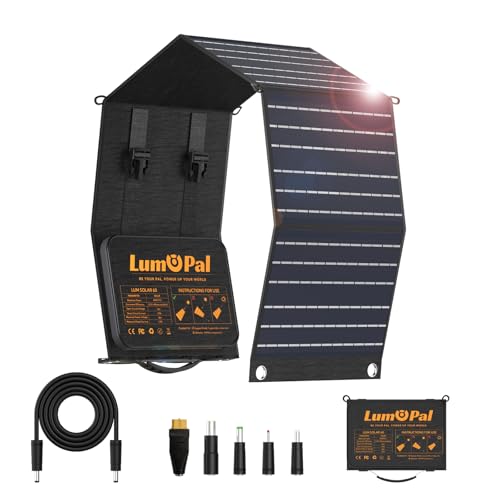
The LUMOPAL 60W is a folding monocrystalline solar charger for camping, hiking, RV trips, and travel. It provides one USB-C PD port rated up to 60W, two USB-A QC3.0 ports up to 22W, and an 18-20V DC port with a 5.5 × 2.1mm plug size. Those connections can charge phones, tablets, cameras, and some laptops or portable power stations. Actual output depends on sunlight and device requirements.
Its 23.5% stated conversion rate is strong for a compact panel. The ETFT-laminated surface should resist abrasion and corrosion better than basic PET coverings. The folded unit measures about 6.7 × 9.5 inches and weighs 3.42 pounds, so it can fit in many camping packs. A pressure rating of up to 176 pounds adds protection during transport. The panel, nylon fabric, and zipper carry IP65 water resistance, but the junction ports are not waterproof. At around $60, it offers several charging options without the bulk of larger panels.
Pros
- USB-C PD output reaches 60W for compatible devices.
- Three USB ports plus DC output support phones, tablets, cameras, and power stations.
- Folds to about 6.7 × 9.5 inches and weighs 3.42 pounds.
Cons
- The junction ports are not waterproof, so they need cover during rain.
- A 60W maximum depends on strong sunlight, correct positioning, and device compatibility.
Buying Guide
The most important factor is panel wattage. A 15-to-25-watt panel usually gives you a better chance of charging phones during daylight than a 5-watt model, though clouds and shade can reduce output sharply.
- Panel wattage: Choose at least 10 watts for one phone, or 20 to 30 watts for two devices. Expect slower charging outside direct midday sun.
- Battery capacity: A built-in 10,000mAh battery can provide roughly one to two phone charges. Pick 20,000mAh for longer trips, but expect extra weight and overnight wall charging.
- Ports and output: Look for USB-C with 18W or higher Power Delivery, plus one USB-A port. Two devices may split power, so check the combined output.
- Packed size and weight: A folding unit under 12 by 8 inches and 2 pounds fits more easily in a daypack. Larger panels collect more sunlight but take more campsite space.
- Weather protection: Choose an IPX4 or higher rating for light rain, reinforced corners, and covered ports. Do not leave the battery in heavy rain unless the maker allows it.
If you cannot have everything, prioritize panel wattage and output, since portability matters less when the charger cannot replenish your devices.
Frequently Asked Questions
How do solar chargers work for camping?
Solar panel chargers for camping convert sunlight into electricity, then send it to a phone, battery pack, or compatible power station. Output drops in clouds, shade, and late afternoon. A compact 20-watt panel may provide one phone top-up during a sunny day, but speed varies by device and weather.
What size solar charger do I need for camping?
A 10- to 20-watt solar charger suits phones and small USB devices, while larger panels better support power stations and multiple devices. For example, a 60-watt model can refill a portable battery more effectively, but it usually weighs more and needs a wider, sunny setup area.
Can solar chargers charge phones overnight?
Solar chargers cannot charge phones overnight unless they include a battery for stored energy. A panel-only model needs sunlight, while a power bank paired with a 20-watt panel may keep charging after sunset until its stored capacity runs out completely.
Are solar panel chargers waterproof for camping?
Not all solar panel chargers are waterproof, so campers should check the product’s IP rating before exposing one to rain. An IPX4 rating handles splashes, while stronger protection may be needed for heavy rain; keep USB ports covered and follow the maker’s weather guidance.
Conclusion
LUMOPAL Portable Solar Panel is the top pick for campers who want a compact, flexible way to recharge phones, power banks, and small USB devices away from outlets. If your priority is higher output for several people or larger battery packs, choose a larger panel with more charging ports, but expect extra weight and bulk in your pack. Before buying, double-check the folded and open size, device and connector compatibility, included cables, panel quantity, and current price, since listings and bundles can change. Also check the charging limits of your power bank, because a panel cannot safely replace a suitable wall charger or battery pack. For short trips, portability may matter more than peak wattage.