
7 Best Solar Panel to Charge a Car Battery for RVs
The Voltset Solar Battery Charger Maintainer Kit is the top pick for most buyers and the best solar panel to charge a car battery when you need to maintain a parked vehicle. Its main advantage is the all-in-one design, which combines a solar panel with a battery-maintainer setup for cars that sit unused for days or weeks.
This guide is for drivers storing cars, trucks, motorcycles, RVs, or other vehicles between trips. The most important factors are panel output and connection options, since they affect charging speed and compatibility with your battery. Weather resistance also matters if the unit will stay outdoors. The 7 picks below are ranked with clear reasons and honest drawbacks for each, so you can compare compact maintainers with larger solar charging systems before buying.
Quick Comparison
| # | Product | Best For | Price | |
|---|---|---|---|---|
| 1 | Voltset Solar Battery Charger Maintainer Kit | Off-grid vehicle battery owners | $35.99 | View → |
| 2 | SUNER POWER 12W 12V Solar Battery Charger & Maintainer | Daily parked car maintenance | — | View → |
| 3 | POWOXI 7.5W Solar Battery Trickle Charger Maintainer | Small vehicle battery upkeep | — | View → |
| 4 | FlexSolar Solar Panel Battery Trickle Charger | Portable outdoor battery charging | $35.99 | View → |
| 5 | SUNER POWER PRO Solar Battery Charger & Maintainer | Multiple vehicle battery maintenance | $99.95 | View → |
| 6 | Sunway 12V Solar Car Battery Trickle Charger | Long-term car parking protection | $22.99 | View → |
| 7 | SUNAPEX Solar Battery Charger | Budget-conscious battery upkeep | $22.99 | View → |
7 Solar Chargers for Car Batteries
This ranked list counts down from practical budget options to the top solar charger for maintaining a car battery.
7. SUNAPEX Solar Battery Charger

Best for: Seasonal cars and boats
The SUNAPEX 12V solar maintainer helps prevent battery drain in vehicles and outdoor equipment that sit unused. It connects through a cigarette lighter plug or alligator clips, so you can charge through an accessory socket or attach directly to the battery. The panel is listed as compatible with sealed lead-acid, AGM, GEL, flooded, lithium, and LiFePO4 batteries. At around $23, it costs less than many powered battery maintainers.
A built-in controller stops charging when the battery reaches full voltage and resumes when the level drops. Two indicator lights show sunlight exposure and charging activity. The panel uses a glass photovoltaic surface, an ABS frame, and a sealed waterproof housing. Suction cups support window mounting, while the portable design works for cars, lawnmowers, boats, and other 12V equipment. SUNAPEX also includes a one-year warranty and lifetime technical support. Still, the listing does not provide the panel’s wattage or physical dimensions, which makes charging speed harder to judge.
Pros
- Includes both a 12V cigarette lighter plug and alligator clips for flexible installation.
- Automatic charge control helps prevent overcharging and battery drain.
- Waterproof construction, suction cups, and two status lights suit outdoor vehicle storage.
Cons
- Solar output depends on sunlight, so charging can slow sharply during cloudy weather, shade, or winter.
- The missing wattage specification makes it difficult to estimate charging time or confirm suitability for larger batteries.
6. Sunway 12V Solar Car Battery Trickle Charger
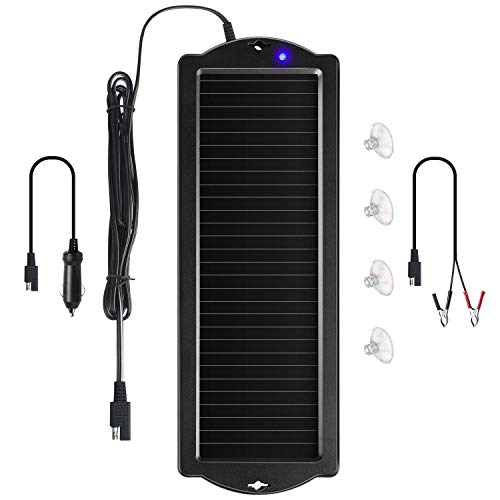
Best for: Long-term vehicle battery maintenance
The Sunway is a compact 12V solar maintainer for cars, motorcycles, boats, RVs, snowmobiles, and other vehicles with rechargeable batteries. Its 1.8-watt amorphous panel feeds a small maintenance charge through either the cigarette lighter plug or included alligator clamps. A built-in blocking diode helps prevent reverse charging, while a blinking LED shows charge activity. At under $25, it offers a low-cost way to offset battery drain during storage.
The panel can sit on a dashboard or windshield with the included suction cup. Its ultra-clear PV glass covers a durable ABS plastic housing, which should handle normal vehicle-storage conditions better than a bare panel. The amorphous design can still produce some power under cloudy skies, but output remains limited. This charger is meant to maintain a healthy 12V battery, not quickly recover one that is deeply discharged. Also, a cigarette lighter connection only works if that outlet remains active when the vehicle is off.
Pros
- Includes both a cigarette lighter plug and alligator battery clamps.
- The blocking diode helps prevent reverse current into the panel.
- Suction-cup mounting supports dashboard or windshield placement.
Cons
- The 1.8-watt output is too low for fast charging or reviving a dead battery.
- Cigarette lighter use depends on the vehicle’s outlet wiring and power settings.
5. SUNER POWER PRO Solar Battery Charger & Maintainer

Best for: Maintaining 12V vehicle batteries outdoors
This 50W solar panel charger maintains 12V batteries in cars, boats, RVs, trailers, trucks, and other parked equipment. Its built-in MPPT controller adjusts charging as sunlight changes, with claimed tracking efficiency up to 99% and peak conversion efficiency up to 98%. The system costs around $100, so it targets owners who want a more capable maintainer than a small plug-in trickle charger.
The three-stage cycle moves through bulk, absorption, and float charging. It stops at full charge, then resumes when voltage drops. Four indicator levels, 25%, 50%, 75%, and 100%, show the current charging status. You can choose standard 12V, 12V AGM, or 12V lithium mode. That covers flooded, gel, AGM, SLA, VRLA, maintenance-free, and LiFePO4 batteries, provided the selected mode matches the battery. Waterproof construction, reverse-polarity protection, short-circuit protection, and temperature safeguards add useful protection. Included suction cups and plug-and-play cables simplify mounting, though the panel still needs direct sun for meaningful charging.
Pros
- 50W output provides more charging capacity than compact maintenance panels.
- Three charging stages help maintain battery voltage without constant supervision.
- Three selectable modes support common lead-acid and LiFePO4 batteries.
Cons
- Charging slows sharply in shade, cloudy weather, or poor panel placement.
- The system suits maintenance and slow recovery, not fast charging of heavily depleted batteries.
4. FlexSolar Solar Panel Battery Trickle Charger

Best for: Vehicles parked for weeks
This 20-watt solar panel is designed to maintain 12-volt batteries in cars, boats, RVs, and motorcycles. It uses monocrystalline cells with a claimed 20% to 25% conversion efficiency under standard test conditions. At about 0.11 inches thick, the flexible panel can fit curved areas such as windshields, sunroofs, and boat decks. Included suction cups and carabiners provide mounting options without drilling. The listed price is around $36.
Connection is straightforward, with four included choices: a cigarette lighter plug, alligator clips, an OBDII adapter, and ring terminals. Its built-in controller cycles charging based on battery voltage, stopping when the battery reaches full capacity and restarting when voltage drops. It also blocks reverse current, which helps prevent the panel from draining the battery at night. This is a maintenance charger, not a replacement for a wall charger or a system made to refill a deeply discharged battery. Performance still depends on available sunlight and panel placement.
Pros
- Four connection methods support cars, boats, RVs, and motorcycles.
- The 0.11-inch flexible body fits curved mounting locations.
- Automatic charge cycling helps protect a 12-volt battery from overcharging and reverse drain.
Cons
- The 20-watt output is intended for battery maintenance, not deep-cycle or heavily discharged batteries.
- Solar output drops with shade, cloudy weather, and poor panel positioning.
3. POWOXI 7.5W Solar Battery Trickle Charger Maintainer
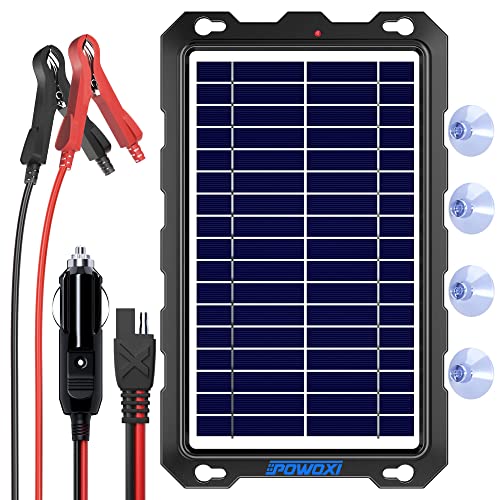
Best for: Maintaining parked 12V vehicles
This 7.5W solar battery maintainer helps reduce battery drain in cars, motorcycles, boats, RVs, trailers, snowmobiles, and other 12V equipment. It connects through a cigar lighter socket or the included alligator clips. The panel uses solar silicon cells with a stated 25% to 30% conversion efficiency, though charging speed still depends on sunlight and battery condition.
The panel has high-transparency, low-iron tempered glass and an ABS+PC frame. That frame resists bending and avoids the paint-scratch concern associated with some aluminum frames. Its built-in controller includes overcharge, overvoltage, short-circuit, and reverse-current protection. A two-color LED shows the panel’s status, with red for sunlight reception and green for battery charging. The unit is designed for outdoor use, but the listing does not provide dimensions or a detailed weatherproof rating. POWOXI lists 12 months of after-sales service and lifetime technical support.
Pros
- 7.5W output can help maintain a parked 12V battery over time.
- Dual connection options support cigar lighter sockets and direct battery charging.
- Tempered glass and an ABS+PC frame offer more rigidity than flexible panels.
Cons
- Solar charging slows or stops in shade, cloudy weather, and at night.
- It is a maintainer, not a fast charger for a deeply discharged battery. A switched-off vehicle outlet may also prevent charging.
2. SUNER POWER 12W 12V Solar Battery Charger & Maintainer
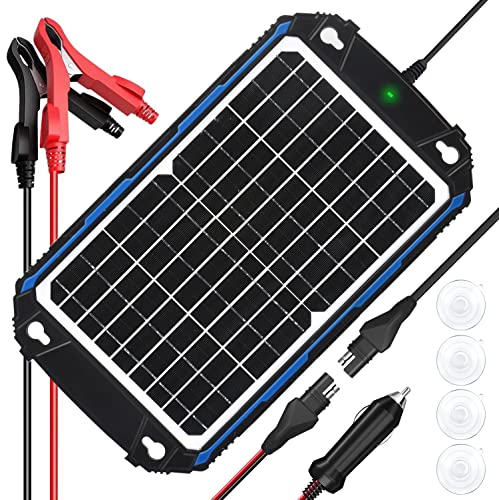
Best for: Owners storing 12V vehicles outdoors
The SUNER POWER 12W solar charger maintains 12-volt batteries in cars, boats, RVs, trailers, motorcycles, tractors, and ATVs. It works with flooded, gel, AGM, SLA, maintenance-free, and LiFePO4 batteries. The panel uses tempered solar glass, Grade A+ cells, and a corrosion-resistant frame. Its claimed cell efficiency reaches 21% to 30%.
Its built-in MPPT controller follows a three-stage charging process: bulk, absorption, and float. The maker rates tracking efficiency up to 99% and conversion efficiency up to 98%, though real output depends on sunlight, panel angle, and battery condition. The charger stops after reaching full charge, then resumes when voltage drops. Eight protection types cover issues such as reverse polarity, short circuits, over-current, over-temperature, and overcharging. Suction cups and plug-and-play cables simplify installation, while the waterproof, spark-proof design suits outdoor storage.
Pros
- Three-stage charging supports safer long-term battery maintenance.
- MPPT control can use available sunlight more efficiently than basic trickle chargers.
- Waterproof construction and multiple safety protections suit boats, RVs, and outdoor vehicles.
Cons
- At 12 watts, it is better for maintenance than quickly charging a deeply drained battery.
- Solar output varies with clouds, shade, panel angle, and seasonal daylight, so it cannot provide steady charging in every location.
1. Voltset Solar Battery Charger Maintainer Kit
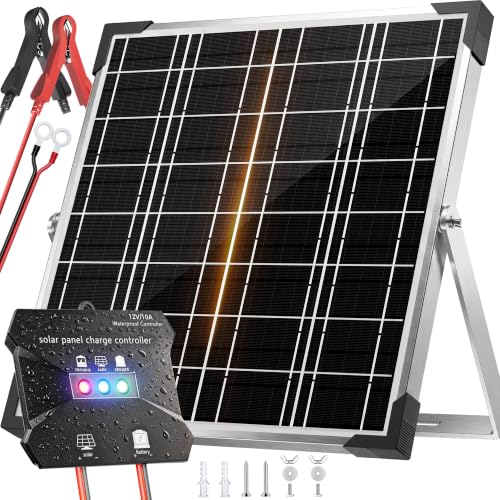
Best for: Parked cars, RVs, and boats
Voltset’s 20W, 12V solar charger helps maintain batteries during storage or light use. Its monocrystalline panel feeds a charge controller that the listing identifies as MPPT, with claimed charging gains of 20% to 30% over basic tracking. It suits cars, trailers, campers, boats, and similar setups where a battery needs a steady top-up instead of fast charging. The price is around $36.
The controller supports LiFePO4, AGM, gel, flooded, and lithium-ion 12V batteries. Buyers should still confirm the correct charging profile for their battery. Protection circuits cover overcharge, over-discharge, short circuits, and reversed connections. The panel and housing carry an IP67 rating, with a stated operating range from -40°F to 185°F. Pre-drilled holes simplify mounting, while LEDs show charge levels from 25% to 100%. The advertised 25-plus-year service life is a manufacturer claim, not a guarantee.
Pros
- 20W output can help offset standby drain on parked 12V vehicles.
- IP67 protection suits outdoor mounting near rain, spray, and dust.
- Safety controls reduce the risk of common wiring and charging faults.
Cons
- A 20W panel will charge large or deeply depleted batteries slowly.
- Full output depends on direct sunlight, so shade, clouds, and short winter days reduce performance.
Buying Guide
Battery compatibility matters most when choosing a solar maintainer for a car. A 12-volt lead-acid battery needs controlled charging, or a small panel may cause overcharging and damage.
- Panel wattage: Choose 5 to 10 watts for maintaining a parked car, or 15 to 20 watts when the vehicle has an alarm, tracker, or other steady drain.
- Charge controller: Select a model with a built-in controller, reverse-current protection, and automatic voltage regulation. Avoid connecting an unregulated panel directly to the battery.
- Battery support: Confirm compatibility with flooded lead-acid, AGM, or gel batteries. Lithium batteries need a charger designed for 12-volt LiFePO4 chemistry.
- Cable and mounting: Look for at least a 6-foot cable, battery clamps, and a 12-volt accessory plug. A 12-by-8-inch panel is easier to place on a dashboard, while larger panels need outdoor mounting.
- Weather protection: For outdoor use, choose an IP65-rated panel or higher, plus sealed connectors. A warranty of at least 1 year adds useful protection.
If you must compromise, prioritize a suitable charge controller and correct battery compatibility over panel size.
Frequently Asked Questions
How many watts does a solar panel need to charge a car battery?
A 10-watt solar panel is usually enough to maintain a healthy 12-volt car battery, while a 20- to 50-watt model suits a battery that needs regular recovery. A 10-watt panel typically provides about 0.5 to 0.8 amp in strong sun, though clouds, shade, and panel angle reduce output.
What type of solar charger works best for a car battery?
A monocrystalline panel with a charge controller is the most practical choice for charging a 12-volt car battery. Choose a controller that prevents overcharging, and confirm the panel’s output matches the battery system. A 20-watt setup may work for maintenance, but a deeply discharged battery usually needs a mains charger or dedicated charger.
Can a solar panel charge a dead car battery?
Yes, a solar charger can charge a car battery, but only if its voltage and controller suit the battery and the panel receives enough sunlight. A 12-volt nominal panel can produce roughly 18 to 22 volts without a load, so connect it through a proper controller rather than directly to the battery.
Are solar battery chargers safe to leave connected?
Solar battery chargers are generally safe to leave connected when they include an automatic charge controller designed for the battery type. Look for reverse-current and overcharge protection, then place the panel in unobstructed light. A 5-watt maintainer can preserve charge during storage, but it will not quickly recharge a flat battery.
Conclusion
Voltset Solar Battery Charger Maintainer Kit is the top pick for drivers who want a practical, low-maintenance way to keep a parked car battery topped up between trips. If your priority is portability for roadside use, choose a compact folding solar charger instead, since it packs smaller and is easier to store in a trunk. Before buying, double-check the panel’s physical size, your battery and vehicle compatibility, the number of chargers or cables included, and the current price, since listings and bundles can change. A maintainer can reduce discharge during storage, but it cannot repair an aging battery or replace regular charging when the battery is deeply drained.