
6 Best 3000 Watt Solar Generator for Home Backup
The Jackery HomePower 3600 Plus Portable Power Station is the top pick for most buyers and our best 3000 watt solar generator. Its 3,600-watt output and large battery capacity give it enough headroom for refrigerators, tools, and several smaller devices during an outage. It also fits a broader home-backup role than a small camping battery, though its size and price may exceed casual needs.
This guide is for homeowners, campers, and anyone preparing for outages who needs more than phone charging. For this class of power station, battery capacity and continuous output matter most. Capacity affects how long appliances can run, while output determines which devices can start and stay powered. Charging speed, solar input, weight, and port selection also shape daily use. The six picks below are ranked with clear reasons and honest drawbacks for each, so you can match the battery to your loads and budget.
Quick Comparison
| # | Product | Best For | Price | |
|---|---|---|---|---|
| 1 | Jackery HomePower 3600 Plus Portable Power Station | Whole-home backup shoppers | $2,459.00 | View → |
| 2 | Jackery HomePower 3000 Portable Power Station | Frequent outage preparedness | $1,899.00 | View → |
| 3 | Anker SOLIX S2000 Portable Power Station | Apartment emergency power | $649.99 | View → |
| 4 | Jackery HomePower 3000 Portable Power Station | RV power users | $1,399.00 | View → |
| 5 | EF ECOFLOW DELTA Pro Portable Power Station | High-demand off-grid setups | $1,899.00 | View → |
| 6 | Jackery 1000 v2 Solar Generator | Portable solar beginners | $699.00 | View → |
6 Top 3000-Watt Solar Generator Picks
This ranked list counts down from the sixth choice to the top solar generator, with key strengths and tradeoffs noted.
6. Jackery 1000 v2 Solar Generator

Best for: Campers needing backup power
The Jackery Solar Generator 1000 v2 pairs a 1,070Wh portable power station with a 200W solar panel. Its 1,500W AC output, with a 3,000W surge peak, can support appliances such as refrigerators, electric pots, and some air conditioners. At 23.8 pounds, it is manageable for road trips and emergency storage, though it is not lightweight for extended carrying.
The LFP battery is rated to retain more than 70% capacity after 4,000 charge cycles, with a projected lifespan beyond 10 years. It has three pure sine wave AC outlets, two USB-C ports, one USB-A port, and a 12V car port. One USB-C port supplies up to 100W for compatible devices. AC charging takes about 1.7 hours by default, or one hour with emergency charging enabled in the app. The included panel can reach 80% in about six hours under suitable sunlight. Around $699, the package also includes a five-year warranty.
Pros
- LFP battery supports up to 4,000 charge cycles before dropping below 70% capacity.
- Three AC outlets and four USB or DC ports can charge several devices at once.
- Emergency charging can refill the battery in about one hour through the app.
Cons
- The 200W solar panel needs strong sunlight and takes about six hours to reach 80% capacity.
- The one-hour charge mode requires app activation, while the generator and panel ship separately.
5. EF ECOFLOW DELTA Pro Portable Power Station
Best for: Whole-home backup and off-grid camping
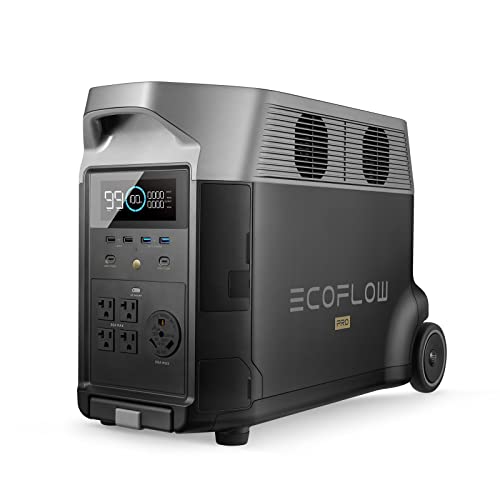
The EF ECOFLOW DELTA Pro is a large portable power station with a 3,600Wh lithium iron phosphate battery. Its 120V AC output supplies 3,600W, or up to 4,500W with X-Boost. Pairing two units can raise total output to 7,200W. The system also supports up to 25kWh with compatible extra batteries and Smart Generators.
It offers 15 connection options, including five AC outlets, two USB-A ports, two fast-charge USB-A ports, two 100W USB-C ports, two DC outlets, a car socket, and an Anderson port. Recharge options include wall power, solar panels, an EV station, a car outlet, or a compatible generator. EcoFlow lists charging times of 1.8 hours from a 240V source, 2.7 hours from an 1,800W wall outlet, or 2.8 hours with four 400W solar panels. Wi-Fi and Bluetooth app controls add useful monitoring for battery level, temperature, and charge settings. At around $1,900, it targets serious backup needs rather than casual phone charging.
Pros
- 3,600Wh capacity supports extended backup sessions.
- Five AC outlets and multiple USB ports power many devices at once.
- LFP chemistry and app controls support monitoring and long-term management.
Cons
- The high purchase price excludes extra batteries and solar panels.
- Its 120V output may not suit appliances that require 240V power.
4. Jackery HomePower 3000 Portable Power Station

Best for: Whole-home outage backup
The Jackery HomePower 3000 is a 3,072Wh portable power station for outages, RV trips, and off-grid work. Its 3,600W AC output, with 7,200W surge capacity, can run a refrigerator, router, lights, fans, and other household essentials. Jackery estimates up to 15 hours of household use, while a refrigerator may run for one to two days, depending on its power draw.
A UL-certified UPS switches within 20 milliseconds, which helps protect devices such as security cameras, medical refrigerators, pet feeders, and computers during an outage. The station includes AC, USB-C, USB-A, DC, and TT-30 RV connections, plus two 100W USB-C ports. It recharges in about 2.2 hours from AC, or 1.7 hours with hybrid AC and DC charging. Two 200W SolarSaga panels can bring it to 80% in about nine hours. Its LiFePO4 battery is rated for 4,000 cycles while retaining 70% capacity. Around $1,400, it costs more than smaller backup batteries, but its 3kWh capacity adds practical emergency coverage.
Pros
- Runs higher-draw appliances with 3,600W output and 7,200W surge capacity.
- UPS response of 20 milliseconds supports sensitive electronics during outages.
- LiFePO4 cells provide a 4,000-cycle rated lifespan and multiple charging options.
Cons
- Solar charging is slow compared with AC, reaching 80% in about nine hours with two 200W panels.
- The high purchase price may exceed the needs of buyers seeking phone, laptop, or router backup.
3. Anker SOLIX S2000 Portable Power Station
Best for: Refrigerator backup during outages
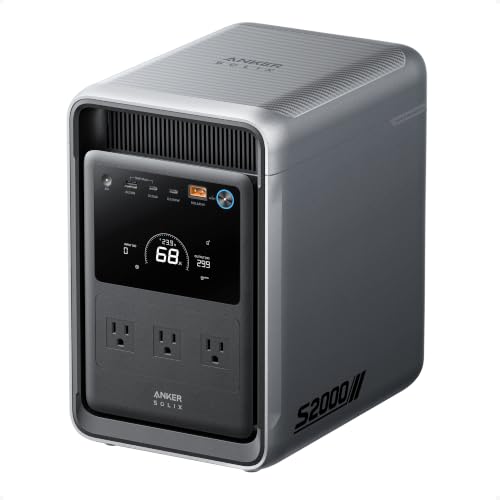
The Anker SOLIX S2000 is a 2,010Wh portable battery for outages, camping, and home-office backup. It delivers 1,500W continuously, with a 3,000W peak for startup surges. That output can cover many essentials, though it will not run every large appliance at once. Eight outlets sit across the front and rear, while a UPS mode switches in under 10 milliseconds for computers and networking gear.
Its compact 8.2 × 11.1 × 12.7-inch body weighs 35.7 pounds, making it easier to move than many 2kWh units. Anker rates the 314Ah LFP battery for up to 10,000 cycles, or roughly 15 years under its stated conditions. The unit can recharge from a wall outlet, generator, car outlet, alternator charger, or solar setup. Solar input reaches 400W. Anker claims up to 35 hours of refrigerator backup, but actual runtime depends on the appliance, temperature, and cycling pattern. At around $650, it offers useful capacity without moving into premium pricing.
Pros
- 2,010Wh capacity can keep a refrigerator or several smaller devices running during an outage.
- LFP cells support up to 10,000 charge cycles, according to Anker.
- Under-10ms UPS switching helps protect desktop computers and network equipment.
Cons
- There is no 12V DC port, limiting compatibility with some camping gear and vehicle accessories.
- The 1,500W continuous rating cannot run high-demand appliances such as many electric heaters or large ovens.
2. Jackery HomePower 3000 Portable Power Station

Best for: Whole-home outage backup and RV trips
The Jackery HomePower 3000 is a 3,072Wh portable battery paired with two 200W solar panels. Its 3,600W AC output, with 7,200W surge capacity, can run essentials such as a refrigerator, router, lights, and fans. Jackery estimates up to 15 hours for a household setup, while refrigerator runtime may reach one to two days, depending on load and cycling.
Its LiFePO4 cells are rated for 4,000 cycles while retaining 70% capacity. A UL-certified UPS switches in 20 milliseconds or less, which suits security cameras, pet feeders, medical refrigerators, and video calls. AC charging takes about 2.2 hours, or 1.7 hours with hybrid AC and DC input. The two panels can restore up to 80% in about nine hours under suitable sunlight. USB-C, USB-A, DC, and a TT-30 RV outlet add flexibility. At around $1,900, it requires a sizable budget. The battery and panels ship separately.
Pros
- 3,600W output handles refrigerators, lights, fans, and other household essentials.
- LiFePO4 battery supports 4,000 cycles before reaching 70% capacity.
- UPS switching within 20 milliseconds protects connected electronics during outages.
Cons
- Solar charging can take about nine hours and depends heavily on sunlight.
- The large battery and two panels require considerable storage space and transport effort.
1. Jackery HomePower 3600 Plus Portable Power Station
Best for: Whole-home outage backup with solar
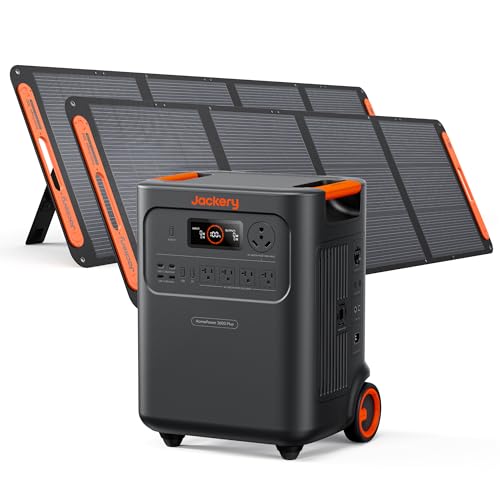
The Jackery HomePower 3600 Plus is a 3,584Wh LFP battery station for outages, RV use, and emergency power. It provides 3,600W of AC output, or up to 7,200W when paired with another unit. Parallel operation can also provide 120V and 240V power for selected household equipment. This package includes two 200W solar panels. At around $2,500, it targets buyers who need more capacity than a small camping power bank.
Its LFP cells use a ceramic membrane and are rated for 6,000 cycles, with a stated 10-year lifespan. Jackery says the cells undergo testing at 302°F and can operate in temperatures down to -4°F. Charging times vary by method: about two hours with hybrid AC and DC, 2.5 hours from AC or a gas generator, and four hours from solar. The wheeled case and telescoping handle make movement easier. Capacity can expand to 21kWh per unit, or 43kWh with multiple units.
Pros
- 3,600W output can support demanding appliances such as pumps, heaters, and dryers.
- Two 200W panels provide a practical solar charging setup for outage use.
- LFP chemistry, 6,000 cycles, and a stated 10-year lifespan support long-term ownership.
Cons
- The high purchase price puts it beyond many occasional emergency-power budgets.
- Solar charging times depend on sunlight, and the station and panels ship in separate packages.
Buying Guide
Battery capacity is the most important factor because a 3,000-watt rating only describes output, not runtime. Choose a unit with enough watt-hours to power your devices for the required outage period.
- Usable battery capacity: Look for 2,000 to 3,000Wh for serious backup. A 100-watt refrigerator load could run roughly 20 to 27 hours, before inverter losses.
- Continuous and surge output: Confirm at least 3,000W continuous output and 6,000W surge capacity. This supports refrigerators, microwaves, pumps, and power tools with startup spikes.
- Solar charging speed: Prefer 500 to 1,000W solar input. In strong sun, that range can refill a 2,000Wh battery in about three to six hours, depending on charging losses.
- Battery chemistry and lifespan: LiFePO4 batteries usually offer better cycle life than older lithium-ion packs. Seek a rated life of at least 3,000 cycles to 80% capacity.
- Portability and price: Check the listed weight before buying. Units above 60 pounds often need wheels or a two-person lift. A realistic price range is about $2,000 to $4,000, excluding panels.
If you cannot get everything, prioritize battery capacity first, then continuous output for your essential appliances.
Frequently Asked Questions
How much can a 3000-watt solar generator power?
A 3000-watt solar generator can run appliances drawing up to about 3000 watts continuously, as long as its battery has enough stored energy. A 3000Wh battery could theoretically run a 300W refrigerator for about 10 hours before inverter losses, cycling, and other loads reduce that estimate.
What should I look for in a 3000-watt portable power station?
Look for 3000 watts of continuous output, a higher surge rating, a large battery, and charging options that fit your needs. A unit with a 3000Wh battery, several AC outlets, and solar input around 1,000 watts offers more useful backup capacity than one with a smaller battery.
Can a 3000-watt battery generator run a refrigerator and air conditioner?
Yes, a 3000-watt battery generator can run both appliances, but usually not at the same time unless their starting and running demands stay below the inverter’s limits. A small refrigerator may use 100 to 300 watts while running, but an air conditioner can briefly need more than 3000 watts during startup.
Are 3000-watt solar power stations worth it for home backup?
They are worth considering for quiet, short-term backup, but they cannot replace a whole-home generator for extended outages. A 3000Wh power station might run a refrigerator, modem, lights, and small electronics for several hours, while heavy loads such as electric heaters can drain the battery quickly.
Conclusion
The Jackery HomePower 3600 Plus Portable Power Station is the top recommendation for homeowners who want a high-output backup unit for outages, appliances, tools, and occasional off-grid use without building a full battery system. If your priority is expandable home backup rather than simpler portability, choose the EcoFlow DELTA Pro, which offers a modular battery approach and fits longer outages or larger loads. Before buying, double-check the unit’s dimensions and weight, confirm compatibility with your solar panels, transfer switch, appliances, and charging setup, verify how many batteries or panels the package includes, and compare the current price across authorized sellers, since bundles can change the overall value significantly.