
6 Best 200 Watt Solar Panel Kit for RVs
The ECO-WORTHY 200W Solar Panel Kit is the best 200 watt solar panel kit for most buyers because it bundles 200 watts of panel capacity with the core charging equipment needed for a basic off-grid setup. That simpler package can reduce guesswork for RVs, sheds, cabins, and backup power projects. It also leaves room to match the system with a suitable battery and inverter later.
This guide is for shoppers who want dependable solar power without piecing together every component separately. The most important factors are panel size, charge-controller type, included mounting hardware, and battery compatibility. Available roof or ground space matters, too, since two 100-watt panels need more room than a single compact panel. The six picks below are ranked by practical value, with clear reasons and honest drawbacks for each.
Quick Comparison
| # | Product | Best For | Price | |
|---|---|---|---|---|
| 1 | ECO-WORTHY 200W Solar Panel Kit | Off-Grid Shed Power Systems | $185.99 | View → |
| 2 | Renogy 200W 12V Solar Panel Kit | RV Battery Charging | $229.72 | View → |
| 3 | DOKIO Portable Foldable Solar Panel Kit | Lightweight Emergency Backup | $129.77 | View → |
| 4 | Renogy 200W 12V Solar Panel Kit | Campervan Electrical Upgrades | $289.99 | View → |
| 5 | DOKIO 200W 18V Solar Panel Kit | High-Voltage Portable Charging | $119.77 | View → |
| 6 | Renogy 200W Portable Solar Panel Suitcase | Foldable RV Power Setup | $322.99 | View → |
Our 6 Top 200-Watt Solar Panel Kits
These kits are ranked by power, included components, portability, and value, counting down to the top pick.
6. Renogy 200W Portable Solar Panel Suitcase
Best for: RV campers needing portable 12V power
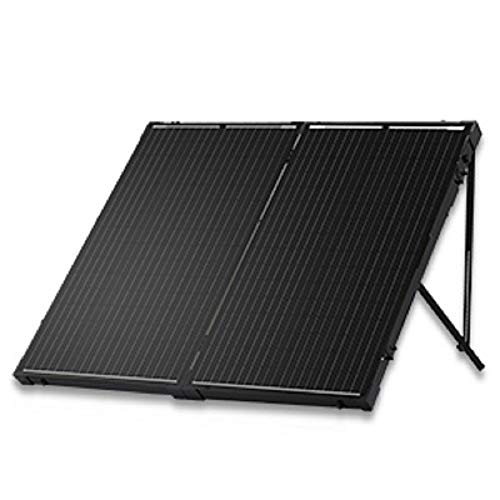
This foldable Renogy solar suitcase provides 200 watts for 12V batteries and portable power stations. N-type cells reach up to 25% conversion efficiency, which can help in weaker sunlight. Renogy estimates as much as 1,000Wh per day with five hours of sun, though actual output depends on shade, angle, weather, and battery condition.
The aluminum kickstand adjusts toward the sun, while the case folds down for storage and transport. At 28.46 pounds, it is portable for RV trips and campsites, but not especially light for longer walks. A built-in 20A PWM charge controller, alligator-clip cables, and four-stage charging reduce setup work. It supports AGM, gel, flooded, and lithium batteries. Low-iron tempered glass and an aluminum frame suit outdoor use, while the IP65 junction box helps protect electrical connections from dust and water. A five-year materials and workmanship warranty adds useful coverage.
Pros
- 200W output and up to 25% cell efficiency suit many 12V charging setups.
- Adjustable aluminum kickstand helps position the panels toward direct sunlight.
- Included 20A controller and cables allow use without buying separate charging hardware.
Cons
- At nearly 29 pounds, this suitcase may feel heavy for hikes or frequent relocation.
- The PWM controller is less efficient than an MPPT model, and 200W output requires strong, direct sunlight.
5. DOKIO 200W 18V Solar Panel Kit
Best for: RV owners building a 12V charging setup
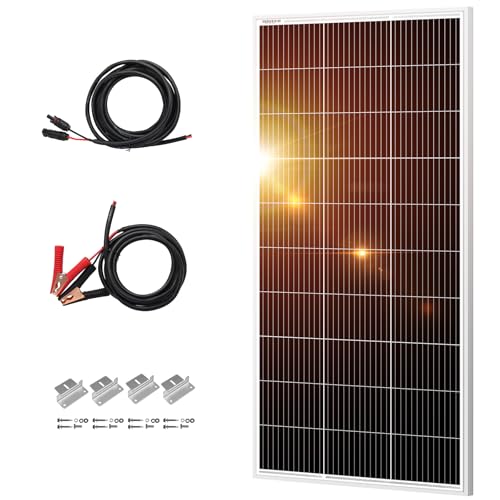
This DOKIO kit pairs one 200W, 18V solar panel with Z-brackets, alligator clips, and a 5 m MC4 cable. It is designed for 12V systems, including RVs, boats, cabins, and small off-grid installations. The panel has pre-drilled mounting holes, so standard brackets can support roof, tilt, or pole installations. At around $120, it provides the main wiring and mounting pieces without pushing the cost too high.
The half-cell layout and bypass diodes help limit power loss when part of the panel sits in shade. They also help manage heat during outdoor use, though output still depends on sunlight, angle, and wiring. The kit does not include a charge controller. You will need a compatible PWM or MPPT model before connecting it to a 12V battery. DOKIO rates the panel for up to 25 years of performance, with low yearly output decline. Reinforced cartons and foam corner protection may also reduce shipping damage, but they do not change the need for careful installation.
Pros
- Includes one 200W panel, Z-brackets, alligator clips, and a 5 m MC4 cable.
- Pre-drilled holes support roof, pole, or angled mounting options.
- Half-cell construction and bypass diodes can reduce shading-related losses.
Cons
- A PWM or MPPT charge controller is required but not included.
- Actual power varies with cloud cover, shading, panel angle, battery condition, and cable losses.
4. Renogy 200W 12V Solar Panel Kit
Best for: RV owners with modest daily loads
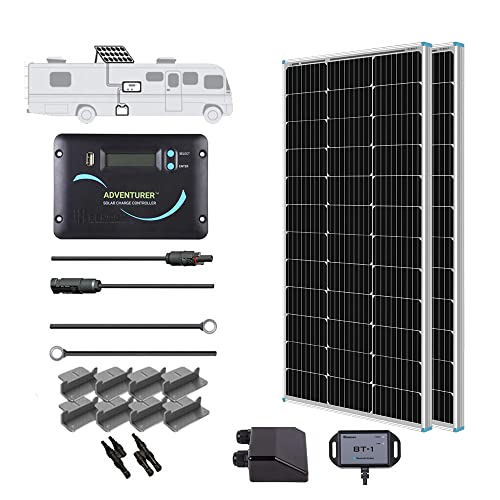
The Renogy 200W 12V N-Type kit pairs a solar panel with an Adventurer-Li 30A PWM charge controller. It suits RVs, campers, boats, caravans, and small greenhouses. With about four hours of sunlight, the system can produce up to 800Wh per day, though real output changes with weather, shade, and panel angle. At around $290, it offers a complete starting setup instead of requiring separate panel and controller purchases.
The aluminum panel frame resists corrosion and carries ratings of 2400Pa for wind and 5400Pa for snow. Pre-drilled mounting holes, plug-and-play cables, and three pairs of Y branch connectors simplify parallel-panel wiring. The controller supports lithium, lead-acid, and gel batteries, with safeguards against overcharging, overloads, short circuits, and reverse polarity. Its flush-mount design keeps the controller tidy inside an RV. The mated connections carry an IP67 protection rating, and the system is rated from -40°F to 194°F. Renogy includes a five-year warranty and 24/7 technical support.
Pros
- 22% cell efficiency helps save roof space.
- Supports three common battery types.
- Includes wiring for parallel panel setups.
Cons
- The 30A PWM controller is less efficient than an MPPT model in many conditions.
- The 800Wh daily figure assumes roughly four hours of useful sunlight. Shade and clouds can reduce it sharply.
3. DOKIO Portable Foldable Solar Panel Kit

Best for: RV owners charging 12V batteries
The DOKIO 200W portable solar kit is made for RVs, vans, boats, trailers, and backup power setups. It folds to 20 × 27 × 1.1 inches and weighs 9.7 pounds, so it is easier to store than a fixed rooftop panel. A 9.84-foot cable gives you room to place the panel in sunlight while keeping the controller or power station in a shaded spot. At around $130, it offers a practical charging setup without requiring a permanent installation.
Its standalone PWM controller supports 12V batteries and includes protection against reverse polarity, overcharging, overloads, and short circuits. The controller can also be replaced or upgraded later. Two USB ports can charge phones, lamps, and other small devices from a connected battery. They may provide emergency top-ups in direct sunlight without a battery, but output can change with cloud cover and panel position. Check your power station’s input limit first. A unit capped at 100W or 150W will not accept the panel’s full 200W rating.
Pros
- Folds into a compact 20 × 27 × 1.1-inch size for storage and transport.
- The 9.84-foot cable allows flexible panel and controller placement.
- Dual USB ports provide power for phones and small gadgets.
Cons
- The 9.7-pound weight may feel heavy for frequent hiking or backpacking.
- A PWM controller is less efficient than an MPPT controller, and power station input limits can reduce usable output.
2. Renogy 200W 12V Solar Panel Kit

Best for: Small off-grid battery systems
This Renogy kit combines a 200W, 12V monocrystalline solar panel with a 30A Wanderer PWM charge controller. Under five hours of direct sunlight, the panel is rated to produce about 1,000Wh per day, though real output will vary with weather, shade, panel angle, and battery condition. Its cells can reach 22% efficiency. Bypass diodes help limit the impact of partial shading, while the laminated layers and TPT back sheet protect the panel from physical stress and heat.
The controller supports sealed, gel, flooded, and lithium batteries. Its four charging stages, bulk, boost, float, and equalization, help manage charging instead of sending power continuously at one level. Built-in safeguards cover reverse polarity, overcharging, overloads, and short circuits. The kit includes connection cables, Z-brackets, and a pre-drilled panel frame, so mounting requires fewer separate parts. The system can expand to 400W with compatible panels. At around $230, it suits buyers who want a basic solar setup without sourcing each component separately.
Pros
- 200W of rated solar capacity can provide useful daily energy for lights, small appliances, and battery charging.
- The 30A controller works with four common battery types, including lithium.
- Included cables, Z-brackets, and pre-drilled mounting holes simplify installation.
Cons
- PWM charging is generally less efficient than MPPT, especially when panel and battery voltages differ.
- The advertised 1,000Wh daily output requires strong, direct sunlight for about five hours, so cloudy weather and shading can reduce production substantially.
1. ECO-WORTHY 200W Solar Panel Kit
Best for: RV owners needing basic off-grid power
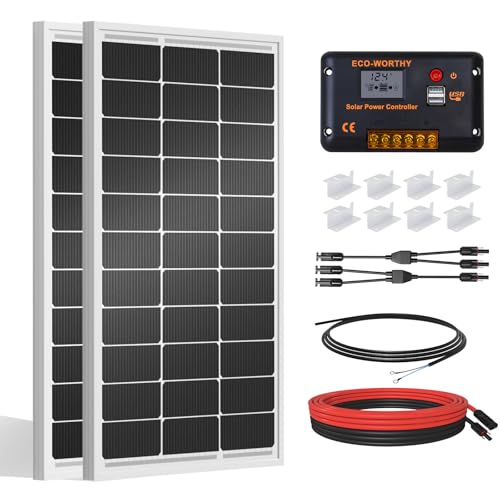
This kit combines two 100-watt monocrystalline solar panels with a 30A PWM charge controller. Together, the panels provide 200 watts of rated power and a claimed daily output of up to 800Wh under four hours of full sunlight. Each panel measures about 35.2 by 23.1 inches, so buyers should check their roof or mounting area first. The package also includes Z brackets, 16.4-foot 10 AWG solar cables, 2-in-1 connectors, and a 4.92-foot tray cable.
The panels use monocrystalline cells with up to 21.5% efficiency in suitable light. Their aluminum alloy frames resist corrosion, while the junction boxes carry an IP65 rating. The panels are rated for 2,400Pa of wind load and 5,400Pa of snow load. Wiring supports either a 12V parallel setup or a 24V series setup, which fits RVs, cabins, trailers, and small backup systems. The price is around $186, before any discounts or changes.
Pros
- Includes two panels, brackets, controller, and cables for a more complete installation.
- Supports both 12V and 24V wiring configurations.
- Aluminum frames and IP65 junction boxes suit outdoor use.
Cons
- The 30A PWM controller is less efficient than an MPPT controller, especially in colder conditions or with longer cable runs.
- The 800Wh daily estimate requires four hours of strong, direct sunlight, so cloudy weather, shade, and seasonal changes will reduce output.
Buying Guide
Panel-to-system compatibility is the most important factor when choosing a 200-watt solar setup. The panel, controller, battery, and inverter need matching voltage ratings, or the rated output will not translate into useful charging.
-
Panel size and output: Rigid panels commonly measure about 58–65 by 26–32 inches. A 200W rating is a laboratory maximum, so real output drops in clouds, shade, and winter sun.
-
Charge controller: Choose an MPPT controller for better performance in changing light. For a 12V battery bank, select at least 20A, while 30A provides useful headroom.
-
Battery match: In four to five strong sun hours, a 200W panel may restore roughly 50–70 amp-hours daily after typical losses. Confirm support for lithium, AGM, or lead-acid batteries.
-
Cables and mounting: Look for 10-foot cables, MC4 connectors, mounting brackets, and a fuse sized for the controller. A bare panel needs these parts separately.
-
Price and coverage: Complete kits typically cost $250–$700, depending on battery inclusion. Seek at least a one-year warranty and clear replacement support.
If you cannot have everything, prioritize voltage compatibility and a correctly sized charge controller.
Frequently Asked Questions
How much power can a 200-watt solar panel kit produce?
A 200-watt solar panel kit can produce up to 200 watts under strong, direct sunlight, but real output is usually lower. Expect roughly 600 to 1,000 watt-hours per day in many locations, depending on sun hours, panel angle, shading, and controller losses. A battery stores power for nighttime use.
What does a 200-watt solar kit include?
A typical 200-watt solar kit includes one or two panels, a charge controller, mounting hardware, and connection cables. Some packages also include a 12-volt battery or inverter, while others sell those parts separately. Check the listing for panel wattage, cable length, controller type, fuse protection, and battery compatibility.
Can a 200-watt solar panel kit power a refrigerator?
A 200-watt solar kit can run small electronics and lights, but it usually cannot power a full-size refrigerator continuously. It may handle phones, LED bulbs, a router, or a laptop through a suitable battery and inverter. A 1,000-watt-hour battery gives useful reserve, though inverter and battery losses reduce usable energy.
Are 200-watt solar kits worth buying for camping and backup power?
They are worth buying for charging small devices, running lights, and maintaining a modest battery, but they are not a whole-home power solution. A complete setup often costs more after adding a battery, inverter, fuses, and mounting parts, so compare the package contents before purchasing.
Conclusion
The ECO-WORTHY 200W Solar Panel Kit is the top recommendation for RV owners, cabin users, and backup-power shoppers who want a complete setup for small appliances and battery charging. If your priority is portability rather than a fixed installation, pick a folding 200-watt solar panel kit instead, since its compact design and carrying features make transport easier. Before buying, double-check the panel and controller size, confirm compatibility with your battery voltage and power station, verify how many panels and cables the package includes, and compare the current price across sellers because kit contents can change. A realistic power budget also helps prevent disappointment on cloudy days or during short winter daylight.