
7 Best Solar Panel Charge Controller for RVs
The Renogy Wanderer 10A PWM Solar Charge Controller is the best solar panel charge controller for most buyers because it offers a simple setup for small 12V and 24V systems. Its 10-amp rating fits modest solar arrays, while the straightforward design keeps installation less confusing for first-time users.
This guide is for campers, shed owners, and backup-power shoppers building compact battery systems. The key factors are controller capacity and battery compatibility, since exceeding the current rating can cause problems, and some models support fewer battery types than others. The seven picks below are ranked with reasons and honest drawbacks for each. You will find options for basic lead-acid setups, lithium batteries, and larger solar arrays. Check your panel output, battery voltage, and wiring before choosing a controller.
Quick Comparison
| # | Product | Best For | Price | |
|---|---|---|---|---|
| 1 | Renogy Wanderer 10A PWM Solar Charge Controller | Small 12V Solar Setups | $24.99 | View → |
| 2 | 30A PWM Solar Charge Controller | Higher-Current PWM Systems | $8.99 | View → |
| 3 | MPPT Solar Charge Controller with LCD Display | LCD Monitoring Fans | $23.39 | View → |
| 4 | Victron Energy SmartSolar MPPT Solar Charge Controller | Bluetooth MPPT Users | — | View → |
| 5 | Renogy Wanderer Li Solar Charge Controller | Lithium Battery Owners | $32.99 | View → |
| 6 | SOLPERK 8A 12V Solar Charge Controller | Compact 8A Installations | $18.99 | View → |
| 7 | SOLPERK 10A Solar Charge Controller | Entry-Level 12V Projects | $19.99 | View → |
7 Top Solar Charge Controllers
These charge controllers are ranked by features, protection, compatibility, and value, counting down to the strongest overall pick.
7. SOLPERK 10A Solar Charge Controller

Best for: Small 12V and 24V battery systems
The SOLPERK 10A solar charge controller manages charging between a solar panel and a deep-cycle battery. It supports 12V systems up to 150W and 24V systems up to 300W, with a 10A maximum current. Compatibility includes AGM, GEL, and flooded batteries. Its IP67 waterproof rating suits outdoor setups such as RVs, boats, and vehicle projects. The controller uses a three-stage PWM charging process and automatically detects 12V or 24V battery voltage.
A simple indicator panel shows three basic conditions: load output, battery status, and solar charging. Green lights identify normal load and battery operation, while a red light indicates charging. The SAE connection supports plug-and-play installation, and two pre-drilled mounting holes give you flexible placement. At around $20, this unit offers useful protection against under-voltage, over-voltage, overloads, short circuits, and reversed battery or panel connections. The package includes the controller, a manual, a 12-month warranty, and technical support.
Pros
- IP67 waterproof construction suits exposed outdoor installations.
- Automatic 12V/24V detection supports two common battery-system voltages.
- Built-in protection covers short circuits, overloads, and reversed connections.
Cons
- The 10A limit restricts suitable panels to 150W at 12V or 300W at 24V.
- PWM charging is generally less efficient than MPPT, and the three lights provide only basic status information.
6. SOLPERK 8A 12V Solar Charge Controller

Best for: Small 12V outdoor battery setups
The SOLPERK 8A charge controller manages power between a 12V solar panel and a 12V rechargeable battery. It supports LiFePO₄, AGM, GEL, and similar battery types, with a maximum charging current of 8A. At around $18, it offers a low-cost option for small solar projects, backup lighting, and outdoor equipment.
Its IP67-rated housing is sealed against rain, snow, and dust, making it suitable for exposed installations. Two LED indicators show basic charging and full-charge status. The controller also includes six protection measures, covering reverse current, overheating, short circuits, overcharging, over-voltage, and reverse polarity. It reportedly stops drawing power from the battery when sunlight is absent. The SAE connector simplifies setup, but the red wire must connect to positive and the black wire to negative. A one-year warranty and lifetime technical support add useful coverage.
Pros
- IP67 waterproof housing helps protect the controller outdoors.
- Six safety protections reduce common battery and wiring risks.
- Supports LiFePO₄, AGM, and GEL 12V batteries.
Cons
- It is limited to 12V systems and an 8A maximum current.
- The two LEDs provide only basic status information, not detailed charging data.
5. Renogy Wanderer Li Solar Charge Controller

Best for: Small 12V RV solar systems
The Renogy Wanderer Li is a 30A PWM charge controller for 12V solar setups. It supports LiFePO4, AGM, gel, and flooded batteries, then adjusts charging through bulk, boost, float, and equalization stages. The controller can handle a compact RV, boat, or basic off-grid battery bank for around $33.
Its small 5.5-by-3.9-by-1.8-inch housing fits crowded electrical compartments. LEDs show the current charging stage, while built-in protection covers reverse polarity, overcharging, overloads, and short circuits. The boost stage holds for 120 minutes before moving toward maintenance charging. Its IP32 rating offers limited protection from dripping water, not full weatherproofing. DIN-rail or wall mounting requires no special mounting tools. Adding Renogy’s separate BT-1 module enables Bluetooth monitoring through the DC Home app, including solar input, battery state of charge, and fault alerts. Temperature compensation also requires that optional module.
Pros
- Supports four common battery chemistries, including lithium, AGM, gel, and flooded types.
- The 30A rating suits many small 12V RV and cabin solar systems.
- Compact housing and DIN-rail mounting work well in tight compartments.
Cons
- PWM charging is less efficient than MPPT technology, especially with higher-voltage solar panels.
- Bluetooth monitoring and temperature compensation require the separate BT-1 module.
4. Victron Energy SmartSolar MPPT Solar Charge Controller

Best for: 12V or 24V off-grid battery systems
The Victron Energy SmartSolar MPPT 100V, 50A is a solar charge controller for small to medium off-grid power setups. It accepts solar input up to 100 volts and can deliver up to 50 amps into a 12V or 24V battery bank. MPPT tracking continually adjusts the operating point, helping capture more available panel power when conditions change or partial shade affects the array. Its charging logic also moves through battery charge stages rather than sending power at one fixed rate.
Its strongest feature is the control and monitoring system. The VictronConnect app provides live operating data and a 30-day performance history, while also supporting battery presets, configuration changes, firmware updates, and alarms. Multiple compatible controllers can coordinate their charging stages, which suits larger systems built from several solar arrays. A programmable load output adds protection by disconnecting connected devices when battery voltage falls too low. The controller does not include a battery, solar panels, wiring, or mounting hardware, so the complete system will cost much more than the controller alone.
Pros
- 100V solar input and 50A output support substantial 12V or 24V charging.
- App access provides live data and 30-day performance history.
- Synchronized charging helps multiple controllers follow the same battery stages.
Cons
- The controller alone is not a complete solar power system.
- A 50A unit may be unnecessary for small panels or low-demand setups.
3. MPPT Solar Charge Controller with LCD Display

Best for: Small 12V or 24V solar systems
This 100A MPPT solar charge controller manages power between solar panels and a battery bank. It automatically detects 12V or 24V systems, but the battery must connect first and have enough charge for recognition. An LCD screen shows operating information and lets you adjust settings for lithium batteries. At under $25, it targets basic home, workshop, RV, and small commercial setups.
The controller claims up to 99% charging efficiency by tracking the panel’s maximum available current. Built-in protection covers overcharging, short circuits, and reverse polarity. Those safeguards can reduce common setup mistakes, but they do not replace correctly sized wiring, fuses, or ventilation. The listing does not provide the maximum solar input voltage, panel wattage limit, or enclosure rating. Confirm those details before connecting a larger array. A 12-month warranty covers quality-related issues, and lifetime technical support is included.
Pros
- Supports automatic 12V and 24V system detection after the battery connects first.
- LCD controls provide live system information and lithium battery adjustments.
- Up to 99% claimed MPPT efficiency can make better use of available solar power.
Cons
- The listing omits maximum PV voltage, maximum panel wattage, and recommended wire sizes.
- A 100A rating does not confirm that the unit can safely handle every solar array or battery bank. Check the full electrical specifications before purchase.
2. 30A PWM Solar Charge Controller

Best for: Small lead-acid solar setups
This 30A PWM solar charge controller manages charging between a solar panel and battery. It supports 12V and 24V systems, with automatic voltage detection instead of a manual selection switch. The LCD shows operating data, while built-in memory keeps user settings after a battery runs out. At under $10, it suits basic home, shed, RV, and backup-power projects.
The controller works only with lead-acid batteries, including open, sealed, and gel types. It should not charge lithium or nickel-metal hydride batteries. A dual USB outlet supplies 5V at up to 2.5A for phones, tablets, or similar devices. Protection covers overcurrent, short circuits, reverse connection, low voltage, overcharging, and backflow. Installation order matters: connect the battery first, then the solar panel. Mount it on a flat, ventilated surface. The included 12-month warranty adds some support for a low-cost regulator.
Pros
- Supports both 12V and 24V solar systems with automatic voltage adaptation.
- LCD controls show system status and support load timing settings.
- Dual USB ports provide up to 5V and 2.5A for small electronics.
Cons
- It is limited to lead-acid batteries and cannot safely charge lithium packs.
- The PWM design is less efficient than an MPPT controller, especially with larger or higher-output solar arrays.
1. Renogy Wanderer 10A PWM Solar Charge Controller
Best for: Small RV and cabin solar systems
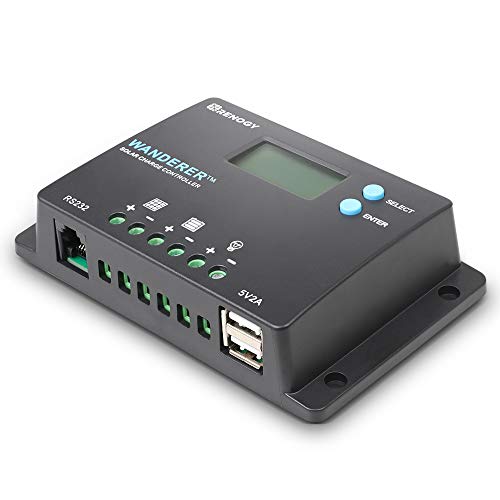
The Renogy Wanderer is a compact PWM charge controller for 12V or 24V battery banks. Its 10A rating suits smaller solar setups, such as a panel system for lights, phones, or basic DC equipment. The unit measures 5.2 by 3.1 inches, so it can fit inside an RV cabinet or marine control panel. At around $25, it offers useful features without the cost of a larger MPPT controller.
Four charging stages, bulk, boost, float, and equalization, support AGM, gel, flooded, and lithium batteries. Lithium use requires manual activation settings. A backlit LCD shows voltage, current, and system status, while the 5V/2A USB port can charge a phone directly. Load control supports manual, automatic, and timed modes for items such as lights or pumps. Protection covers overcharging, overloads, short circuits, reverse polarity, and over-discharge. The RS232 port works with Renogy’s BT-1 Bluetooth module, sold separately. Its IP32 rating offers limited moisture protection, not full weatherproofing.
Pros
- Supports both 12V and 24V battery systems.
- Four-stage charging works with several battery types.
- LCD, USB charging, and timed load controls add convenience.
Cons
- The 10A capacity limits the size of the solar array and connected loads.
- IP32 protection is unsuitable for exposed rain or wet mounting locations.
Buying Guide
Match the controller to your battery voltage and panel current first. A mismatch can stop charging, reduce output, or damage the battery and electronics.
- System voltage: Choose a 12V, 24V, or 48V model that matches your battery bank. A 12V controller cannot safely manage a 24V battery.
- Current rating: Add the panels’ maximum current, then choose a controller rated at least 25% higher. For a 15-amp array, select a 20-amp unit.
- PWM or MPPT: PWM models suit small, low-cost systems under about 200 watts. MPPT models can recover more energy, especially with panels above 200 watts or in cold, cloudy conditions.
- Battery support: Confirm the controller supports your chemistry, such as flooded lead-acid, AGM, gel, or LiFePO4. Lithium batteries need a compatible charging profile and often lack low-temperature charging protection.
- Protection and usability: Look for reverse-polarity, overcurrent, overheating, and low-voltage protection. A screen or app should show charging amps, battery voltage, and daily energy.
If you must compromise, prioritize correct voltage and current capacity before display features or extra charging modes.
Frequently Asked Questions
How do I choose a solar charge controller for my system?
Choose a solar charge controller by matching its battery voltage, panel current, and charging method to your system. A 12-volt battery bank needs a controller rated for 12-volt service, while panel output should stay below the unit’s maximum input current. For example, a 20-amp model suits roughly 240 watts on 12 volts, subject to manufacturer limits.
What is the difference between MPPT and PWM controllers?
MPPT controllers usually harvest more energy than PWM models, especially when panel voltage exceeds battery voltage. MPPT units convert extra voltage into charging current, while PWM units pull panel voltage closer to battery voltage. For example, a 100-watt panel may deliver better results through MPPT in cold or partly shaded conditions.
Can a solar regulator charge lithium batteries?
Yes, a compatible solar regulator can charge lithium batteries, but it must support the battery’s chemistry and required charging profile. Check for lithium or LiFePO4 settings, plus a low-temperature cutoff if the battery maker requires one. A 12-volt LiFePO4 battery typically uses a profile near 14.4 volts, but verify its manual.
Are bigger solar charge controllers always better for a home system?
No, a larger solar controller is not always better; it must match the panel array, battery bank, and system voltage. Check the maximum PV voltage, charging amperage, and battery voltage before connecting anything. For example, a 30-amp controller may support about 400 watts at 12 volts, depending on its specifications.
Conclusion
The Renogy Wanderer 10A PWM Solar Charge Controller is the top pick for small 12V setups, including RV batteries, compact cabins, and basic off-grid lighting systems. If your priority is faster charging, broader battery support, or a larger solar array, choose a higher-current MPPT controller instead, since it can capture more available energy in changing conditions. Before buying, double-check the controller’s physical size, battery and panel compatibility, required quantity for your system, and current price, since model listings and bundles can change. Match the controller to your panel wattage and battery bank, then leave room for future expansion if you expect your power needs to grow. A careful match prevents costly wiring changes later.