
7 Best Cellular Trail Camera With Solar Panel for Hunting
The SPYPOINT FLEX-M Solar Bundle Cellular Trail Camera is the best cellular trail camera with solar panel for most buyers because its included solar setup can reduce routine battery changes. It sends photos over cellular networks, so you can check activity without visiting the camera as often. That makes it a practical choice for wildlife monitoring, hunting land, and properties far from home.
This guide is for shoppers who need remote image access and fewer maintenance trips. Cellular coverage matters most, since a strong camera cannot send photos from a dead zone. Power needs, battery life, image storage, and weather-resistant construction also deserve attention. The seven picks below are ranked with clear reasons and honest drawbacks for each, so you can compare cameras based on your land, network access, and monitoring routine.
Quick Comparison
| # | Product | Best For | Price | |
|---|---|---|---|---|
| 1 | SPYPOINT Flex-M Solar Bundle Cellular Trail Camera | Remote solar scouting | — | View → |
| 2 | MagicEagle Cellular Trail Camera | Budget cellular monitoring | $89.99 | View → |
| 3 | Moultrie Edge Solar Cellular Trail Camera | Low-maintenance solar scouting | $99.99 | View → |
| 4 | Moultrie Edge 3 Cellular Trail Camera | High-resolution game monitoring | $99.99 | View → |
| 5 | 4G LTE Cellular Trail Camera | Basic LTE remote surveillance | $119.99 | View → |
| 6 | 4G LTE 2K PTZ Solar Trail Camera | Pan-tilt solar property monitoring | $99.99 | View → |
| 7 | Stealth Cam Fusion MAX Cellular Trail Camera | Serious hunters needing coverage | $99.99 | View → |
7 Top Solar Cellular Trail Cameras
These cellular game cameras are ranked by connectivity, power options, image quality, and value, counting down to the top pick.
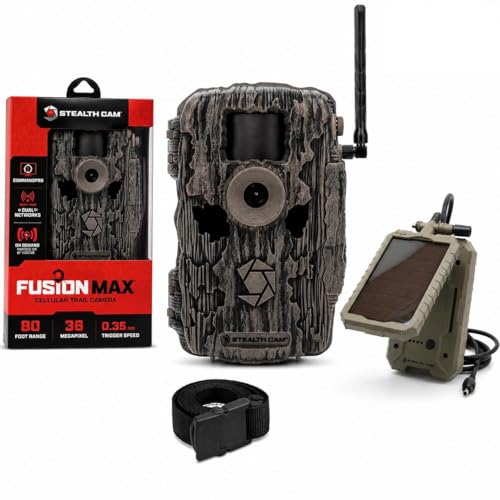
7. Stealth Cam Fusion MAX Cellular Trail Camera
Best for: Remote property deer monitoring
This bundle combines a cellular trail camera with a Stealth Cam Sol-Pak solar panel. The camera captures selectable 4, 8, 16, or 36MP photos, plus 720p video with audio. Its 0.35-second trigger and 80-foot low-glow infrared range cover fast-moving animals in daylight or after dark. Burst mode records one to six images per trigger, which helps when an animal crosses the frame quickly.
The strongest feature is the dual-SIM setup. Preinstalled AT&T and Verizon SIM cards let the camera seek the stronger available network, though coverage still depends on your location. The included solar panel has a built-in rechargeable battery and mounting bracket, reducing the need to replace 16 AA batteries every few weeks. Through the Command Pro app, owners can view images, receive alerts, request photos, and change settings remotely. AI animal recognition, weather data, lunar tracking, and hunting maps add useful tools. At around $100, the bundle includes a lot for a cellular camera, but video resolution remains modest.
Pros
- Solar panel and built-in rechargeable battery reduce routine battery changes.
- Dual-SIM connectivity can switch between AT&T and Verizon coverage.
- Fast trigger, six-image bursts, and 80-foot IR help capture nighttime movement.
Cons
- Cellular operation still requires usable AT&T or Verizon service at the camera site.
- The 720p video resolution is lower than many newer trail cameras.
6. 4G LTE 2K PTZ Solar Trail Camera

Best for: Off-grid farms and rural property
This two-camera 4G LTE system monitors places without Wi-Fi or wired internet. It works on AT&T, T-Mobile, and Verizon US networks, and each camera includes a preinstalled 16GB TF card for local recording. A solar panel charges the built-in 9,000mAh battery, which suits cabins, farms, hunting areas, and construction sites with regular sunlight.
The camera records 4MP video through a 3.6mm wide-angle lens. Infrared night vision reaches 10–20 meters, while a switchable spotlight provides color footage after dark. Remote pan and tilt control, human detection, motion alerts, auto tracking, and two-way audio add useful security functions. The IP65 housing protects against dust and water. Remote viewing requires a separate data plan for each camera. The included 100MB trial lasts seven days, then plans start at about $20 for 30 days. Without service, recordings stay on the card and require on-site removal.
Pros
- Solar charging and a 9,000mAh battery reduce battery changes in sunny locations.
- PTZ control and two-way audio let you check areas and speak remotely.
- Infrared and color night modes cover nighttime monitoring up to 20 meters.
Cons
- Each camera needs its own cellular plan, so the two-pack can create two recurring charges.
- Without an active data plan, there are no remote alerts or viewing, and TF-card files require on-site access.
5. 4G LTE Cellular Trail Camera

Best for: Remote wildlife and property monitoring
This 4G LTE trail camera uses a pre-installed SIM card to send alerts and footage without Wi-Fi. Its 2.5K camera provides a 360° live view through the phone app, while HD and SD recording options help control video quality and data use. Setup takes only a few app-guided steps. The included 100MB of data lets you start monitoring right away, but a separate memory card is required for local storage.
A built-in solar panel helps extend battery life during outdoor use. Six IR LEDs support infrared night vision, while full-color night viewing is also available in suitable conditions. PIR motion sensors can send activity alerts to your phone for wildlife or property security. The AI feature can identify animals and behavior, but it requires a paid subscription. At around $120, this camera offers more remote access than a basic trail camera, though its cellular costs continue after the free data runs out.
Pros
- 2.5K video and 360° live viewing provide broad remote coverage.
- Solar charging and six IR LEDs support long-term day and night monitoring.
- Pre-installed SIM card and 100MB of data allow quick initial setup.
Cons
- The 100MB trial allowance is limited, and each camera needs its own paid data top-up.
- A memory card is not included, and AI species identification requires a subscription.
4. Moultrie Edge 3 Cellular Trail Camera

Best for: Remote deer scouting with app alerts
The Moultrie Edge 3 is a cellular trail camera for property owners who want images without visiting the camera site. It captures 40MP photos and 1080p video, with a 0.5-second trigger and a detection range up to 100 feet. Its low-glow infrared flash helps capture nighttime movement without visible white light. The included 3.4W solar power pack supports longer operation, though the system also works with EDGE Series lithium battery packs.
Its strongest feature is the combination of cellular access and automated animal detection. The camera can connect to the strongest available network among four major U.S. carriers, so it does not require a separate SIM card. The Moultrie app provides instant photo or video alerts, live aiming, GPS camera mapping, and battery checks. AI buck detection can help filter alerts around deer activity. Compatible feeders can also be monitored or adjusted remotely. Plans start at around $10 per month, and activation includes a two-year warranty. At around $100, it offers a lot of remote monitoring hardware for the price.
Pros
- 40MP images and 1080p video provide detailed daytime and nighttime records.
- Four-carrier auto-connect can simplify setup on remote hunting properties.
- Live Aim and built-in GPS make placement easier and easier to track later.
Cons
- Cellular operation requires a paid Moultrie plan, starting at around $10 per month.
- Remote feeder controls only work with compatible Moultrie feeders.
3. Moultrie Edge Solar Cellular Trail Camera

Best for: Remote properties with reliable sunlight
The Moultrie Edge Solar is a cellular trail camera for hunters who want remote access without regular battery changes. Its integrated solar panel charges the built-in battery pack, while the adjustable panel angle helps capture available sunlight. The camera costs around $100, but cellular service starts at $9.99 per month.
Image quality is a strong point. It captures 40MP photos and 1080p video with audio, plus low-glow infrared night images with coverage up to 100 feet. A 0.4-second trigger and 100-foot detection range help record fast-moving animals. The camera automatically selects among four major U.S. networks, so there is no separate SIM card to install. The Moultrie app lets you view photos, request videos, and change settings remotely. Cloud storage removes the need to collect an SD card. AI buck detection can reduce irrelevant alerts, though no animal-recognition system is perfect. The included Easy Aim mount helps with placement, and the housing is built for outdoor exposure. A two-year warranty adds useful coverage.
Pros
- Solar charging and a built-in battery reduce routine battery swaps.
- Four-carrier connectivity can help on remote hunting properties.
- Remote video requests, cloud storage, and app controls simplify scouting.
Cons
- Cellular service adds a recurring cost after purchase.
- Solar performance depends on sunlight, shade, and mounting direction.
2. MagicEagle Cellular Trail Camera

Best for: Remote wildlife and property monitoring
This cellular trail camera costs around $90 and sends photos, short videos, and live-view footage over 4G. Its cloud-based network setup does not require a physical SIM card. A 5MP camera records sharper detail than basic 2MP models, while the 0.3-second trigger helps catch quick animal movement. The 940nm no-glow infrared LEDs support discreet night monitoring without visible red flashes.
Power is a strong point. The built-in 13,000mAh battery is rated for up to three months of standby use, and an optional MagicEagle solar panel can reduce charging trips. The IP66 housing resists dust and rain, with a stated operating range from -20°C to 50°C. A gravity sensor, GPS location tools, and movement alerts add protection if someone moves the unit. The app also offers animal recognition, activity data, temperature, and humidity records. A free 100MB plan covers about 200 photos or 16 short videos for 30 days after activation.
Pros
- No physical SIM card is needed for 4G setup.
- The 5MP camera, 0.3-second trigger, and no-glow IR support detailed day and night captures.
- The 13,000mAh battery and optional solar panel suit long-term field placement.
Cons
- Cellular use depends on available carrier coverage and requires paid data after the limited free plan.
- The solar panel is optional, and the camera’s advanced app features may be unnecessary for simple local recording.
1. SPYPOINT Flex-M Solar Bundle Cellular Trail Camera

Best for: Remote property and game monitoring
The SPYPOINT FLEX-M Solar Bundle pairs a cellular trail camera with the SPLB-10 solar panel, an installation strap, and a heavy-duty mounting arm. It uses dual-SIM LTE, so it can send photos through the SPYPOINT app without WiFi. GPS, motion detection, and IP65 water resistance support outdoor placement, while night vision helps with after-dark activity.
The camera captures 28MP photos and 720p video with sound. Its Photo, Video, Time-Lapse, and Time-Lapse+ modes fit different scouting needs. Constant Capture can send images while continuing to record, and the app supports remote settings, firmware updates, maps, weather, and BUCK TRACKER AI filtering. A free plan allows up to 100 photos per month. Paid options start at $5 monthly for 250 photos, or $15 for unlimited photos, with a seven-day trial. The camera requires a 32GB microSD card. An optional LIT-22 battery can extend field use.
Pros
- Solar panel, mounting arm, and strap come in one bundle.
- Sends photos to phones, tablets, or computers without WiFi.
- 28MP photos, 720p video with sound, and four capture modes offer flexible scouting.
Cons
- Cellular service is required, so remote areas with weak coverage may limit uploads.
- The free plan caps transmissions at 100 photos monthly, and the 32GB microSD card is required but not listed as included.
Buying Guide
The most important factor is cellular coverage at the camera site. Without a reliable signal, the unit cannot send photos, alerts, or status reports, even with strong batteries and a clear view.
- Network compatibility: Confirm support for the carrier used at the property, such as Verizon, AT&T, or T-Mobile. Check coverage with the carrier’s map, then look for a camera supporting 4G LTE rather than older 3G service.
- Solar and battery power: Choose a panel measuring at least 5 by 5 inches, with a rechargeable battery of 8,000 mAh or more. A 10,000 mAh battery gives better reserve during cloudy stretches.
- Trigger and image performance: Look for a trigger speed of 0.3 seconds or less and a detection range near 65 to 100 feet. For nighttime wildlife, select infrared illumination with no-glow LEDs.
- Weather and mounting: Choose an IP66-rated housing or better for rain and dust. A 1.5-inch tree strap fits many trunks, but a locking box adds protection on public land.
- Data costs and storage: Review monthly plans before buying. Light use may need 1,000 photos monthly, while video plans can cost $10 to $30 per month.
If you cannot have everything, prioritize dependable cellular coverage at the camera’s exact location.
Frequently Asked Questions
How does a cellular trail camera with a solar panel work?
A cellular trail camera with a solar panel sends photos or video through a mobile network while the panel recharges its battery. It needs a compatible SIM plan, cellular coverage, and a clear view of the sky. Many panels use a cable connection, so mounting the panel within 5 to 10 feet can simplify installation.
What should I look for when choosing a solar-powered cellular trail camera?
Look for reliable network support, low power use, weather protection, and a data plan that fits your monthly budget. Check for IP66 or IP67 protection, a replaceable battery, adjustable photo triggers, and an app that shows signal strength before you mount the unit in a remote spot.
Can solar-powered cellular game cameras work through winter?
Yes, solar-powered cellular game cameras can work through winter if the panel receives enough daylight and the battery tolerates low temperatures. Short days and snow can reduce charging, so place the panel south-facing where practical and keep it clear. A camera under trees may need a larger battery or occasional charging during weeks of heavy cloud.
Are cellular trail cameras with solar panels worth the cost?
They are worth the cost for remote locations where frequent battery changes would be difficult or expensive. A solar setup can reduce service trips, but it still requires cellular service, a data subscription, and a clear panel position. Expect the initial purchase to include the camera, panel, mounting hardware, and often a rechargeable battery.
Conclusion
SPYPOINT Flex-M Solar Bundle Cellular Trail Camera is the strongest fit for landowners who want a ready-to-use setup, solar charging, remote image access, and fewer visits to a property with no nearby power. If your priority is lower upfront cost, simpler controls, or broader carrier support, choose a compatible cellular trail camera sold without the solar bundle, then add a panel only if its input and mounting system match. Before buying, double-check the camera and panel dimensions, cellular-network compatibility in your hunting area, how many cameras and accessories the package includes, and the current price, since bundles and carrier plans can change. A careful check can prevent installation problems and surprise monthly expenses later.