
7 Best Portable Solar Panels for RV Battery Charging Trips
For the best portable solar panels for rv battery charging, Renogy 100W Portable Solar Panel is the top pick for most buyers because its 100-watt rating offers a useful balance between charging capacity and manageable portability. It gives RV owners a straightforward starting point without jumping to a larger, heavier setup. The panel is also easier to match with common battery-charging systems than smaller units that may produce limited power.
This guide is for RV travelers, dry campers, and anyone who wants backup charging away from shore power. The key details are panel wattage, folded size, connector compatibility, and weather-resistant construction. Wattage affects how quickly the panel can replenish a battery, while size matters when storage space is tight. Connector types can determine whether extra adapters are needed. The seven picks below are ranked with clear reasons and honest drawbacks for each, so you can choose a solar charger that fits your rig and routine.
Quick Comparison
| # | Product | Best For | Price | |
|---|---|---|---|---|
| 1 | Renogy 100W Portable Solar Panel | Compact RV Power Needs | $229.30 | View → |
| 2 | Voltset Solar Panel Battery Charger | Emergency Battery Top-Ups | $35.99 | View → |
| 3 | Renogy 200W 12V Portable Solar Panel Suitcase | High-Capacity Camper Charging | $322.99 | View → |
| 4 | DOKIO 200W Foldable Solar Panel Kit | Portable Off-Grid Power | $129.77 | View → |
| 5 | Voltset Solar Panel Kit | Complete Solar Starter Kit | $139.95 | View → |
| 6 | Jackery Solar Generator 1000 v2 | Backup Power For Appliances | $699.00 | View → |
| 7 | ACOPOWER 200W Portable Solar Panel Kit | Large-Panel Outdoor Charging | $278.50 | View → |
7 Portable Solar Panels for RVs
These portable panels are ranked by charging practicality, setup needs, and RV compatibility, counting down to the top pick.
7. ACOPOWER 200W Portable Solar Panel Kit

Best for: RV owners needing portable 12V charging
The ACOPOWER 200W Portable Solar Panel Kit is a foldable charging setup for 12V batteries, RVs, camper trailers, boats, and compatible solar generators. It includes a 20A charge controller, adjustable kickstands, a carrying handle, and Anderson plus universal solar connectors. The panel folds for transport, so it fits better into travel gear than a fixed rooftop array.
Its main advantage is the mix of output and portability. A 200W panel can provide useful daytime charging for a 12V battery or power station when sunlight is strong. The controller adds protection against overcharging, overloads, short circuits, and reverse connections. The outdoor-ready construction and waterproof design suit camping, marine use, emergency backup, and off-grid trips. At around $279, it costs more than small solar panels, but the higher wattage and included controller add value. Actual charging speed will depend on sunlight, panel angle, cable losses, and the connected battery or generator.
Pros
- 200W output provides more charging capacity than compact travel panels.
- Included 20A controller helps protect compatible 12V batteries.
- Foldable frame, handle, and kickstands support transport and outdoor setup.
Cons
- Charging performance drops in clouds, shade, and poor panel positions.
- Anderson or universal connectors may not match every power station without an adapter.
6. Jackery Solar Generator 1000 v2

Best for: Camping, outages, and road trips
The Jackery Solar Generator 1000 v2 pairs a 1,070Wh portable power station with a 200W solar panel. Its 1,500W AC output, with a 3,000W surge peak, can handle several common appliances, such as refrigerators, electric pots, and some air conditioners. At 23.8 pounds, it is easier to transport than larger backup batteries, and the foldable handle helps with storage.
Its LFP battery is rated to keep more than 70% capacity after 4,000 charge cycles, or over 10 years under the stated conditions. Charging takes about 1.7 hours by default, while the Jackery app can enable a one-hour emergency charge. Solar charging reaches 80% in six hours under suitable conditions. The unit includes three pure sine wave AC outlets, two USB-C ports, one USB-A port, a DC car port, and LED lights. One USB-C port supports 100W charging without a separate adapter. At around $699, the package offers useful capacity, but buyers should understand the charging and delivery details.
Pros
- LFP battery supports over 4,000 cycles while retaining more than 70% capacity.
- Three AC outlets and multiple USB ports can power devices at the same time.
- App controls include emergency charging, a 30 dB quiet mode, and energy-saving settings.
Cons
- The one-hour recharge requires enabling emergency charging in the app each time.
- The generator and 200W panel ship separately, which can delay receiving the complete kit.
5. Voltset Solar Panel Kit

Best for: RV owners charging 12V batteries
The Voltset kit pairs a 100W monocrystalline solar panel with a 20A charge controller for 12V battery systems. It includes an alligator-clip cable and four Z mounting brackets, so buyers get the main connection and mounting pieces in one package. The controller supports LiFePO4, AGM, Gel, flooded, and lithium-ion batteries. It also has USB and USB-C ports for smaller devices.
Its LCD screen displays charging information and battery status, while LED indicators provide quick visual feedback. A button lets you view current for five seconds or change battery modes after holding it for three seconds. The panel uses an aluminum frame and IP67-rated weather protection. Voltset claims a service life of up to 25 years and more than 500 watt-hours per day in strong sunlight. That output depends heavily on sun exposure, panel angle, and weather.
Pros
- Supports five common 12V battery types, including LiFePO4 and AGM.
- Includes USB and USB-C charging ports for phones and small electronics.
- IP67 protection, an aluminum frame, and four mounting brackets suit outdoor setups.
Cons
- The advertised daily output requires sufficient sunlight, so cloudy or shaded locations will produce less power.
- The kit does not include a battery, inverter, or detailed mounting hardware beyond the four Z brackets.
4. DOKIO 200W Foldable Solar Panel Kit

Best for: RV and van battery charging
The DOKIO 200W kit is a foldable solar panel system for charging a 12V battery, power station, or small off-grid setup. It weighs 9.7 pounds and folds to 20 × 27 × 1.1 inches, so it can fit in an RV compartment, van, boat, or emergency storage area. The 9.84-foot cable lets you place the panel in stronger sunlight while keeping the controller and battery in a shaded spot.
Its separate PWM controller is a practical feature for basic 12V systems. It includes protection against reverse polarity, overcharging, overloads, and short circuits. The controller is also replaceable if it fails or if you later want a different charging setup. Two USB ports can power phones, lamps, and other small devices from a connected battery. They may also provide emergency phone charging without a battery, but output can change with sunlight. At around $130, this kit offers useful portability, though the full 200W rating may not suit every power station.
Pros
- Folds to 20 × 27 × 1.1 inches for easier storage and transport.
- Includes a 9.84-foot cable for flexible panel placement.
- Separate controller provides four basic safety protections.
Cons
- Some power stations limit solar input to 100W or 150W, so they cannot use the full 200W rating.
- The PWM controller may collect less energy than an MPPT controller in some conditions.
3. Renogy 200W 12V Portable Solar Panel Suitcase
Best for: Car campers charging 12V batteries
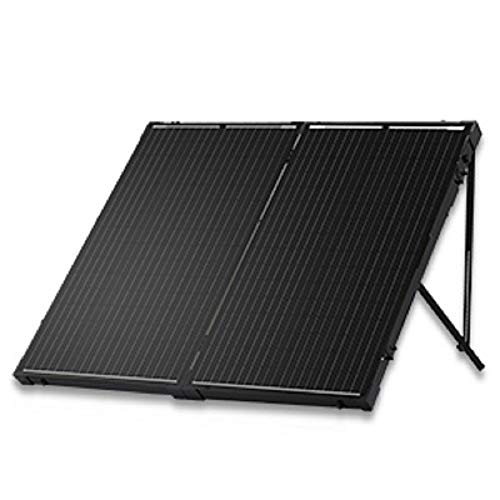
The Renogy 200W suitcase panel is a foldable solar charger for 12V battery setups, portable power stations, RVs, and off-grid use. It weighs 28.46 pounds and includes an adjustable aluminum kickstand, so you can angle the glass panels toward the sun without a separate stand. Folded, it stores like a suitcase and needs no permanent installation.
Its N-Type solar cells can reach 25% conversion efficiency, while the included waterproof 20A PWM controller manages charging through four stages. Renogy says the panel can produce up to 1,000Wh per day with five hours of sunlight, though clouds, shade, heat, and panel angle will reduce that figure. Alligator-clip cables support Gel, AGM, flooded, and lithium batteries. Low-iron tempered glass, an aluminum frame, and an IP65-rated junction box suit outdoor use. A five-year materials and workmanship warranty adds useful coverage. At around $323, it costs more than many basic folding panels, but includes the controller and stand.
Pros
- 200W output and up to 25% cell efficiency suit regular 12V charging.
- Adjustable aluminum kickstand helps improve sun angle during the day.
- Four-stage, 20A controller supports several common battery types.
Cons
- At 28.46 pounds, it is heavy for hiking or frequent hand-carrying.
- The included PWM controller is less efficient than an MPPT model, especially in changing conditions.
2. Voltset Solar Panel Battery Charger
Best for: Maintaining parked 12V batteries outdoors
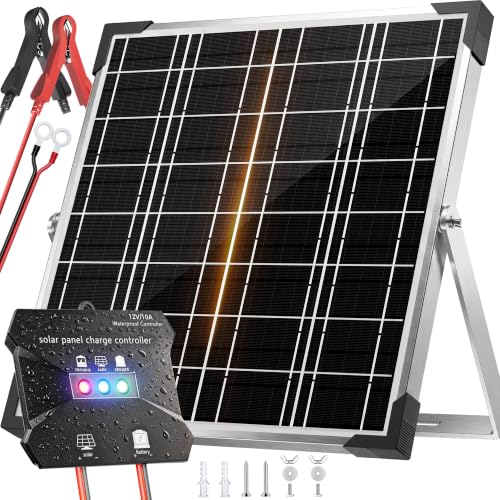
The Voltset is a 20W solar maintainer for 12V batteries in cars, RVs, boats, trailers, and similar equipment. Its monocrystalline panel pairs with an MPPT controller, which the listing says can charge 20% to 30% faster than basic tracking systems. At around $36, it costs less than many larger solar kits, but it still needs direct sunlight to produce useful power.
Protection features cover overcharging, over-discharging, short circuits, and reverse polarity. The controller also stops drawing power at night, then resumes charging when battery voltage falls. It supports LiFePO4, AGM, gel, flooded, and lithium-ion batteries, though buyers should confirm the correct charging profile for their specific battery. An IP67 weather-resistant design and a stated operating range of -40°F to 185°F suit year-round outdoor mounting. Pre-drilled holes simplify installation, while LED indicators show charge levels from 25% to 100%. The claimed 25-year lifespan applies to the panel and materials, not necessarily the entire kit.
Pros
- MPPT control may improve charging speed over basic solar controllers.
- IP67 construction supports use on exposed boats, RVs, and trailers.
- Built-in protections reduce the risk of common wiring and charging faults.
Cons
- A 20W panel maintains batteries well but can recharge a deeply depleted battery slowly.
- Solar output drops in shade, cloudy weather, snow, and short winter daylight.
1. Renogy 100W Portable Solar Panel

Best for: Car campers charging 12V batteries
The Renogy 100W Portable Solar Panel is a foldable charging kit for campsites, RVs, and backup power. N-Type cells offer up to 25% conversion efficiency, while the adjustable aluminum kickstand helps aim the panel at the sun. Renogy estimates as much as 500Wh per day with five hours of sunlight, though real output will vary with weather, shading, and panel angle. The folded unit weighs 17.42 pounds and stores like a suitcase.
A built-in 20A PWM controller and alligator-clip cables make battery connections straightforward. Its four-stage charging system supports 12V power stations plus AGM, gel, flooded, and lithium batteries. Low-iron tempered glass, an aluminum frame, an IP65 junction box, and bypass diodes add protection for outdoor use. The panel includes a five-year materials and workmanship warranty. At around $229, it costs more than basic 100W folding panels, but includes the controller and wiring.
Pros
- N-Type cells provide a rated efficiency of up to 25%, useful when roof or campsite space is limited.
- The adjustable kickstand allows better sun positioning without a separate stand.
- The included 20A PWM controller supports several 12V battery types and uses four charging stages.
Cons
- At 17.42 pounds, it is portable but heavy for frequent hikes or long-distance carrying.
- A PWM controller is less efficient than an MPPT model, and the claimed 500Wh daily output depends on strong, unobstructed sunlight.
Buying Guide
The most important factor is usable wattage, not the panel’s peak rating. A 100-watt panel may produce only 50 to 80 watts in real sun, so match output to your RV battery’s size and daily use.
- Panel wattage: Choose 100 to 200 watts for a typical 12-volt, 100Ah battery. A 200-watt setup can replace roughly 50 to 70 amp-hours on a sunny day, depending on location and system losses.
- Charge controller: Select a controller rated above the array’s maximum current. For 200 watts at 12 volts, choose at least 20 amps. MPPT controllers usually capture more energy than basic PWM models.
- Battery compatibility: Confirm support for AGM, gel, flooded lead-acid, or LiFePO4 batteries. Lithium batteries need a controller with a lithium setting and the correct charging voltage.
- Portability: Check folded dimensions and weight. A practical RV kit may fold below 25 by 25 inches and weigh under 25 pounds.
- Connections and protection: Look for MC4 connectors, a 10-foot cable, reverse-polarity protection, and an IP65 or better panel rating. A 1-year warranty is a sensible minimum.
If choices conflict, prioritize adequate wattage and a compatible charge controller.
Frequently Asked Questions
How do portable solar panels charge an RV battery?
Portable solar panels charge an RV battery by converting sunlight into electricity, then sending that power through a charge controller to the battery. A 100-watt panel can provide useful daytime charging, but output changes with sun angle, shade, panel temperature, and controller type. Connect the controller to the battery before connecting the panel.
What size portable solar panel is needed to charge an RV battery?
An RV battery usually needs a 100- to 200-watt portable solar setup for routine daytime charging, though capacity and daily use determine the right size. A 100Ah lead-acid battery may need roughly 100 watts for light use, while a 200Ah bank or frequent inverter use may call for 200 watts or more.
Can a portable solar charger power an RV battery on cloudy days?
Yes, a portable solar charger can charge an RV battery on cloudy days, but it will produce less power and may take longer. Thick clouds can reduce output substantially, so a panel rated at 200 watts might deliver far below that rating. Keep essential loads low, and use a battery monitor to track actual charging.
Are folding solar panels a good choice for RV battery charging?
Yes, folding solar panels are a good choice for RV battery charging when easy storage and quick setup matter more than maximum roof-mounted output. Many portable kits fold into two or more sections and include a built-in stand. Check the packed size, cable length, weather rating, and controller compatibility before buying.
Conclusion
Renogy 100W Portable Solar Panel is the top pick for RV owners who want a practical, packable charger for routine battery top-ups. If your priority is maximum daily energy rather than easy storage, choose a higher-wattage rooftop panel instead, since a fixed setup can collect power without being unpacked at each stop. Before buying, double-check the panel’s folded and open size, your battery and charge-controller compatibility, the number of panels your setup can support, and the current price. Also confirm whether the package includes the cables, adapters, and carrying case you need. Portable solar works best in direct sun, so shade, clouds, and campsite orientation can reduce charging speed. Match your choice to your travel habits and available storage space.