
7 Best Solar Battery Maintainer for RV Camping
The SUNER POWER Pro 12V Solar Battery Charger is the best solar battery maintainer for rv and our top pick for most buyers because its compact solar panel helps keep a parked 12-volt battery charged without shore power. It fits RVs, campers, boats, and other vehicles that sit unused between trips. The setup uses a panel and charging leads, with placement near a sunny window or exterior mounting spot.
This guide is for RV owners who want to reduce battery drain during storage, travel, or long periods away from a campsite. Panel size, cable length, weather resistance, and battery compatibility matter most when comparing these low-power chargers. A maintainer should support the battery without adding much setup or storage bulk. The 7 picks below are ranked with clear reasons and honest drawbacks for each, so you can choose a model that fits your rig and parking conditions.
Quick Comparison
| # | Product | Best For | Price | |
|---|---|---|---|---|
| 1 | SUNER POWER Pro 12V Solar Battery Charger | For RV and boat owners | — | View → |
| 2 | Voltset 20W Solar Battery Charger | For budget-conscious 20W charging | $35.99 | View → |
| 3 | SOLPERK 20W 12V Solar Panel Kit | For DIY 12V installations | — | View → |
| 4 | POWOXI 7.5W Solar Battery Trickle Charger | For low-draw battery upkeep | — | View → |
| 5 | SUNER POWER PRO Solar Battery Charger & Maintainer | For long-term parked vehicles | $99.95 | View → |
| 6 | SUNER POWER PRO Solar Battery Trickle Charger & Maintainer | For seasonal vehicle storage | — | View → |
| 7 | SUNER POWER PRO Solar Battery Charger & Maintainer | For daily outdoor battery maintenance | $79.95 | View → |
7 Solar Battery Maintainers for RVs
These picks are ranked by charging performance, panel size, durability, and value, counting down to the top choice.
7. SUNER POWER PRO Solar Battery Charger & Maintainer

Best for: Parked cars, boats, and RVs
The SUNER POWER PRO is a 30-watt solar charger and maintainer for 12-volt batteries. It fits vehicles that sit unused, including cars, boats, RVs, trailers, trucks, and powersports equipment. Its built-in MPPT controller manages charging without requiring a separate unit. SUNER POWER claims up to 99% tracking efficiency and 98% peak conversion efficiency, though real output depends on sunlight, placement, and battery condition.
The charger uses a three-stage cycle: bulk, absorption, and float. It stops when the battery reaches full charge, then resumes after voltage drops. Three selectable modes support standard 12V batteries, 12V AGM batteries, and 12V lithium batteries, including LiFePO4 models. Front indicators show approximate charge levels at 25%, 50%, 75%, and 100%. The waterproof housing includes protection against reverse polarity, short circuits, overcharging, over-temperature, and other electrical faults. Included suction cups and plug-and-play cables simplify mounting. At around $80, it costs more than basic trickle chargers, but combines the panel and controller in one unit.
Pros
- Three charging modes support flooded, AGM, gel, SLA, and LiFePO4 batteries.
- Automatic float maintenance reduces the need for frequent monitoring.
- Waterproof construction and multiple safety protections suit outdoor vehicle storage.
Cons
- A 30-watt panel may charge large or deeply depleted batteries slowly.
- Solar output drops in shade, cloudy weather, and poor panel angles.
6. SUNER POWER PRO Solar Battery Trickle Charger & Maintainer

Best for: Seasonal storage of 12V vehicles
The SUNER POWER PRO is a 20W solar charger and maintainer for 12V batteries. Its integrated MPPT controller uses bulk, absorption, and float charging stages. The unit stops charging when the battery is full, then resumes after voltage drops. That suits cars, boats, RVs, trailers, and motorcycles stored for long periods.
The panel uses Grade A+ solar cells, tempered glass, and a corrosion-resistant frame. The company rates the cells at 21% to 30% efficiency, with up to 99% tracking efficiency and 98% peak conversion efficiency. Actual output depends on sunlight and placement. Protection covers overcharging, reverse polarity, short circuits, excess current, and high temperatures. The kit includes mounting screws, pre-drilled holes, and plug-in cables. It supports flooded, gel, AGM, SLA, maintenance-free, and LiFePO4 batteries. Check the battery maker’s charging requirements first.
Pros
- Three-stage charging reduces the need for manual monitoring.
- MPPT control can improve energy use in changing sunlight.
- Weather-resistant materials suit outdoor vehicle storage.
Cons
- The 20W panel maintains batteries but charges deeply drained ones slowly.
- Clouds, shade, panel angle, and short winter days reduce charging output.
5. SUNER POWER PRO Solar Battery Charger & Maintainer

Best for: Outdoor 12V battery maintenance
The SUNER POWER 50W solar charger maintains 12V batteries in cars, boats, RVs, trailers, trucks, and other equipment. Its built-in MPPT controller adjusts the solar input through three charging stages: bulk, absorption, and float. The system stops charging at full capacity and resumes when the battery voltage drops. That setup suits storage vehicles and equipment that sit unused for weeks.
A front indicator shows approximate charge levels at 25%, 50%, 75%, and 100%. You can choose standard 12V, 12V AGM, or 12V lithium mode, with support for flooded, gel, SLA, VRLA, maintenance-free, and LiFePO4 batteries. The panel is waterproof, and included suction cups and plug-in cables simplify temporary mounting. At around $100, it costs more than basic trickle chargers, but its automatic controls and battery-type settings add useful flexibility. Sunlight still controls the charging rate, so this is a maintainer rather than a fast recovery charger.
Pros
- Three charging modes support standard, AGM, and LiFePO4 batteries.
- MPPT control can improve solar energy use in changing light.
- Built-in protections cover reverse polarity, short circuits, over-voltage, and overheating.
Cons
- A 50W panel may charge slowly during cloudy weather or with larger batteries.
- Suction-cup mounting works best on clean, smooth surfaces and may not suit permanent installation.
4. POWOXI 7.5W Solar Battery Trickle Charger
Best for: Vehicles parked outdoors between trips
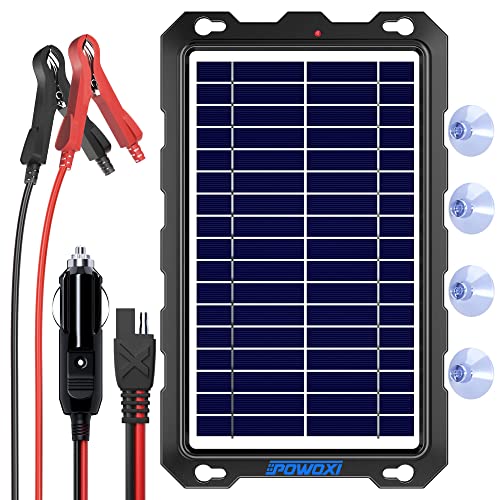
The POWOXI 7.5W solar maintainer keeps a 12V battery topped up when a car, motorcycle, boat, RV, trailer, or snowmobile sits unused. It connects through a 12V accessory socket or directly to the battery with alligator clips. That gives buyers two installation options, though the socket must remain active when the vehicle is off.
The panel uses low-iron tempered glass and an ABS+PC frame instead of a flexible sheet or aluminum edging. That design should resist bending, scratches, wind, and snow without risking contact between metal and car paint. Its claimed conversion efficiency is 25% to 30%, but real output will vary with sunlight, panel angle, and shade. A built-in controller includes overcharge, overvoltage, short-circuit, and reverse-current protection. Red and green indicator lights show sunlight reception and battery connection. POWOXI also lists a 12-month service period and lifetime technical support.
Pros
- The 7.5W output can help offset gradual battery drain during storage.
- Tempered glass and an ABS+PC frame offer more physical protection than flexible panels.
- Socket and alligator-clip connections suit different vehicle setups.
Cons
- Solar charging slows sharply in shade, cloudy weather, winter conditions, or poor panel placement.
- This is a maintainer, not a replacement for a full battery charger when the 12V battery is deeply discharged.
3. SOLPERK 20W 12V Solar Panel Kit
Best for: Maintaining parked 12V vehicle batteries
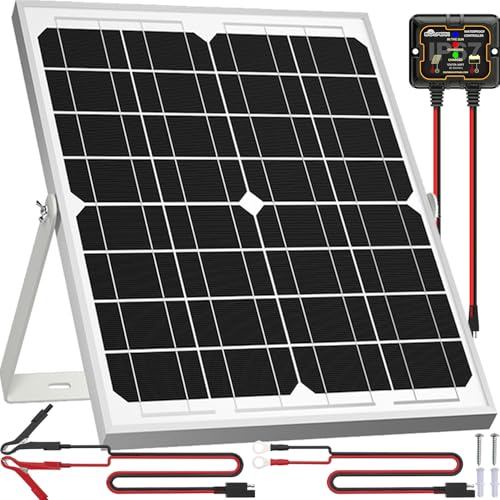
This 20W solar charger uses monocrystalline cells to maintain 12V rechargeable batteries in cars, boats, motorcycles, RVs, tractors, and lawn equipment. It includes an 8A smart controller with three-stage charging, plus alligator clips and O-rings for different connection setups. The controller’s two indicator lights show charging status.
The panel uses low-iron tempered glass and a corrosion-resistant aluminum frame. SOLPERK rates it for up to 25 years of service, with resistance to 2,400Pa of wind pressure and 5,400Pa of snow load. Its 360-degree adjustable bracket helps position the panel toward the sun, while pre-drilled holes and plug-and-play cables simplify setup. The kit supports several battery types, including LiFePO₄, lithium-ion, AGM, SLA, GEL, EFB, and MF. It can help maintain a battery during storage, but 20W is better suited to slow upkeep than fast charging.
Pros
- Includes an 8A controller with three-stage charging protection against overcharging, over-voltage, and short circuits.
- Tempered glass and an aluminum frame provide weather resistance for outdoor vehicle use.
- The adjustable bracket, mounting hardware, and multiple cable options support flexible installation.
Cons
- A 20W panel may charge large or deeply depleted batteries slowly, especially during cloudy weather.
- The kit does not include a battery, and buyers must place the panel where it receives direct sunlight.
2. Voltset 20W Solar Battery Charger
Best for: Maintaining 12V batteries outdoors
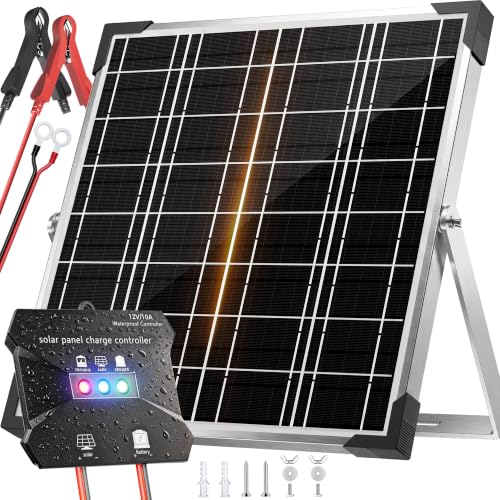
The Voltset is a 20W solar charger for keeping 12V batteries topped up during storage or light use. It fits cars, RVs, boats, trailers, gate openers, and dump trailers. Its monocrystalline panel feeds a built-in controller, which manages charging instead of leaving the battery connected directly to the panel. Voltset claims its MPPT system can charge 20% to 30% faster than basic solar controllers, though output will still depend on sunlight and battery condition.
The kit supports LiFePO4, AGM, gel, flooded, and lithium-ion batteries. That broad compatibility is useful, but buyers should confirm the battery’s required charging profile before connecting it. The controller includes protection against overcharging, excessive discharge, short circuits, and reversed connections. It also stops nighttime drain, resumes when voltage falls, and uses LEDs to show status from 25% to 100%. The IP67 housing is rated for rain and dust, with a stated operating range from -40°F to 185°F. At around $36, it offers more control than a basic panel, but it is still a maintenance charger, not a fast replacement for a wall charger.
Pros
- 20W output helps maintain stored car, RV, boat, and trailer batteries.
- MPPT tracking may improve charging speed by 20% to 30% over basic controllers.
- IP67 protection and a stated -40°F to 185°F range suit outdoor installations.
Cons
- Charging slows sharply in shade, cloudy weather, or winter sunlight.
- Buyers must verify battery chemistry and charging requirements, especially with lithium-ion batteries.
1. SUNER POWER Pro 12V Solar Battery Charger

Best for: Maintaining parked 12V vehicles
The SUNER POWER 12W solar charger maintains 12-volt batteries in cars, boats, RVs, trailers, motorcycles, tractors, and ATVs. It supports flooded, gel, AGM, SLA, maintenance-free, and LiFePO4 batteries. The panel uses tempered solar glass, a corrosion-resistant frame, and Grade A+ cells rated for 21% to 30% efficiency. Its waterproof, UV-resistant build suits outdoor mounting.
A three-stage charging process handles bulk, absorption, and float charging. The charger stops when the battery reaches full charge, then resumes after voltage drops. Its built-in MPPT controller claims up to 99% tracking efficiency and 98% peak conversion efficiency, though real output depends on sunlight, panel angle, and battery condition. Eight protection systems cover issues such as reverse polarity, overcharging, short circuits, over-temperature, and excess current. Plug-and-play cables and included suction cups make setup straightforward, but the 12W output is intended for maintenance rather than fast recovery.
Pros
- Three-stage charging helps maintain battery voltage without constant supervision.
- MPPT control can use available sunlight more effectively than basic controllers.
- Waterproof construction and multiple safety protections suit outdoor vehicles.
Cons
- The 12W output may take a long time to recharge a deeply discharged battery.
- Solar performance drops in shade, cloudy weather, and poor mounting angles.
Buying Guide
The most important factor is panel output matched to your RV battery’s standby drain. A 10-watt unit can offset light parasitic loads, but larger banks or alarms may need 15 to 25 watts and a regulated charge controller.
- Power and battery match: Choose 5 to 10 watts for one 12-volt battery with low drain, or 15 to 25 watts for two batteries or heavier standby use. Confirm compatibility with lead-acid, AGM, or lithium batteries.
- Charge control: Prefer a controller with overcharge and reverse-polarity protection. For a 12-volt lead-acid battery, a float range near 13.2 to 13.6 volts is suitable. Lithium batteries need a matching charge profile.
- Panel construction: Choose a weather-resistant panel rated for outdoor use, with a 6- to 10-foot cable. A 10- to 20-watt panel often measures roughly 13 by 9 inches.
- Connection options: Ring terminals suit permanent battery connections. SAE plugs or alligator clips work for temporary use. A replaceable fuse near the positive terminal adds protection.
- Mounting and cost: Suction cups, adhesive pads, or screw holes should fit your window or battery compartment. Expect to spend about $25 to $80 for a small regulated kit.
If you must compromise, prioritize correct wattage and charge regulation for safe, steady battery maintenance.
Frequently Asked Questions
How do I choose a solar battery maintainer for my RV?
Choose a maintainer that matches your battery voltage, chemistry, and storage needs. For a 12-volt lead-acid house battery, a 5 to 20-watt panel with a charge controller may replace normal standby drain, but larger banks, shaded parking, or alarms can require more panel capacity. Check the manufacturer’s charging limits.
What size solar panel is enough to maintain an RV battery?
A 10-watt panel can maintain one healthy 12-volt battery with low standby drain in good sunlight, while a 20-watt model offers more reserve. Actual output drops with shade, dirt, short winter days, and panel angle, so use a regulated maintainer and confirm the battery’s resting condition before storage.
Can I leave a solar battery charger connected to my camper all winter?
Yes, you can leave a properly regulated solar maintainer connected during winter storage, provided it matches the battery and includes overcharge protection. A 12-volt lead-acid battery should remain fully charged, while lithium batteries may require a charger with a lithium-specific profile. Inspect connections and clear snow or debris from the panel after storms.
Are solar battery maintainers safe for RV lithium batteries?
Solar maintainers are safe for RV lithium batteries only when the charger supports the battery’s lithium chemistry and voltage. A 12-volt LiFePO4 battery typically needs a LiFePO4 charging profile, not a basic lead-acid setting. Follow the battery maker’s storage guidance, especially below 32°F, when many lithium batteries should not be charged.
Conclusion
SUNER POWER Pro 12V Solar Battery Charger is the top pick for RV owners who want a straightforward way to help maintain a 12-volt battery during storage, especially when the coach sits outdoors with useful sunlight. If your priority is easier packing or a lower purchase cost, choose a smaller solar maintainer instead, since it takes less space and may suit occasional storage better, although charging support can be more limited. Before buying, double-check the panel’s physical size against your storage area, confirm compatibility with your battery type and 12-volt system, verify how many batteries you need to maintain, and compare the current price across trusted retailers, since listings and discounts can change.