
5 Best Solar Panel to Charge Deep Cycle Battery for RVs
The SUNER POWER Pro Solar Battery Charger & Maintainer is the best solar panel to charge deep cycle battery for most buyers. Its main advantage is a maintenance-focused design that helps keep compatible 12V batteries charged without grid power, making it a practical fit for parked vehicles, boats, and small off-grid setups.
This guide is for anyone maintaining a deep-cycle battery with sunlight, including RV, boat, cabin, and backup-system owners. The key factors are panel output and battery compatibility, since a low-wattage charger may maintain a battery but recharge it slowly. Build quality, mounting options, and overcharge protection also affect daily use. The five picks below are ranked by their strengths, with clear reasons and honest drawbacks for each, so you can match a charger to your battery and available sunlight.
Quick Comparison
| # | Product | Best For | Price | |
|---|---|---|---|---|
| 1 | SUNER POWER Pro Solar Battery Charger & Maintainer | Off-Grid Battery Maintenance | — | View → |
| 2 | SUNER POWER PRO Solar Battery Charger & Maintainer | Larger Vehicle Battery Care | $99.95 | View → |
| 3 | Voltset 100W 12V Solar Panel Kit | 12V Backup Power Projects | $139.95 | View → |
| 4 | SOLPERK Solar Panel Kit | Small RV Solar Setups | $94.99 | View → |
| 5 | 12V 100Ah LiFePO4 Lithium Battery with Smart BMS | Long-Lasting Marine Power | $146.98 | View → |
5 Top Solar Chargers for Deep-Cycle Batteries
These solar chargers are ranked by charging potential, battery compatibility, and value, counting down to the top pick.
5. 12V 100Ah LiFePO4 Lithium Battery with Smart BMS

Best for: RV owners needing lightweight house power
This 12V 100Ah LiFePO4 battery stores 1,280Wh and uses a 100A smart BMS for overcharge, over-discharge, over-current, and short-circuit protection. It measures 12.9 by 6.69 by 8.5 inches and weighs 24 pounds, fitting many Group 31 battery boxes. The sealed, lead-free design needs no acid refills or routine maintenance.
Its strongest feature is the built-in low-temperature charging cutoff. Charging stops below 32°F, helping protect the cells, while discharge is rated from -4°F to 140°F. The battery claims 6,000 cycles at 100% depth of discharge and up to 15,000 cycles at 60% depth of discharge, with a projected service life beyond 10 years. Four batteries can connect in series and four parallel strings can create a 20.48kWh bank. Self-discharge stays below 3% per month, which suits seasonal camping and emergency backup use. At around $147, it offers substantial capacity for the price, though long-term cycle claims depend on charging, temperature, and load conditions.
Pros
- Weighs 24 pounds, making it much easier to move than a comparable lead-acid battery.
- The 100A BMS provides multiple electrical protections and low-temperature charging cutoff.
- Supports 4S4P expansion, allowing systems up to 51.2V and 400Ah.
Cons
- It cannot charge below 32°F, so cold-weather installations may need insulation or battery heating.
- Series and parallel setups require compatible chargers, wiring, and careful battery matching.
4. SOLPERK Solar Panel Kit

Best for: Maintaining parked 12V vehicle batteries
The SOLPERK kit combines a 50W monocrystalline solar panel with a 10A charge controller for maintaining rechargeable 12V batteries. It supports LiFePO₄, lithium-ion, AGM, SLA, GEL, EFB, and MF batteries. The package includes alligator clips, an SAE extension cable, and four sets of mounting pieces. At around $95, it costs more than basic trickle chargers but offers a broader installation package.
The panel uses low-iron tempered glass and a corrosion-resistant aluminum frame. SOLPERK rates it for 21% to 30% cell efficiency, with resistance to up to 2,400Pa of wind pressure and 5,400Pa of snow load. Its IP65 controller uses three-stage charging and three indicator lights, so you can monitor charging status. The panel and controller are listed as waterproof, but the product title says “without mounting bracket.” Buyers should confirm what the included mounting pieces support before planning a roof or wall installation.
Pros
- Supports several 12V battery types, including LiFePO₄, AGM, SLA, and GEL.
- Tempered glass and an aluminum frame resist corrosion and outdoor exposure.
- Includes a 10A controller, alligator clips, SAE cable, and mounting hardware.
Cons
- A 50W panel maintains batteries but may charge larger, deeply drained batteries slowly.
- The kit may not include a full adjustable mounting bracket, despite the feature description.
3. Voltset 100W 12V Solar Panel Kit

Best for: RV owners charging 12V batteries
The Voltset kit combines a 100W monocrystalline solar panel with a 20A smart charge controller for basic off-grid battery charging. It supports LiFePO4, AGM, Gel, flooded, and lithium-ion 12V batteries. The package includes an alligator-clip cable and four Z-shaped mounting brackets, so it covers the main parts needed to get started. A battery is not included.
The controller has an LCD screen, LED indicators, USB, and USB-C ports for small devices. It can show current for five seconds and switch battery modes after holding the button for three seconds. Built-in safeguards cover overcharging, excess voltage, overcurrent, short circuits, reverse polarity, and overheating. The aluminum-framed panel has weather-resistant construction, pre-drilled mounting holes, and an IP67 rating. Voltset claims more than 500Wh per day in sufficient sunlight and a service life of up to 25 years. Actual output will vary with weather, shade, season, and panel placement. At around $140, this is a practical starter setup, but not a complete power system.
Pros
- Supports five common 12V battery types, including LiFePO4 and AGM.
- LCD monitoring and selectable charging modes make battery status easier to track.
- Includes four mounting brackets, an alligator-clip cable, and USB charging ports.
Cons
- The 100W panel depends heavily on direct sunlight, so daily output can fall sharply in cloudy or shaded conditions.
- No battery, inverter, or long-term wiring extension is included, which adds cost for a full installation.
2. SUNER POWER PRO Solar Battery Charger & Maintainer

Best for: Maintaining parked 12V batteries
The SUNER POWER 50W solar charger keeps 12V batteries topped up in cars, boats, RVs, trailers, trucks, and other parked equipment. Its built-in MPPT controller manages charging through bulk, absorption, and float stages. The panel stops when the battery reaches full charge, then resumes after voltage drops. That makes it better suited to long-term storage than a basic trickle charger.
Three charging modes support standard 12V batteries, AGM batteries, and LiFePO4 lithium batteries. Four indicators show approximate charge levels at 25%, 50%, 75%, and 100%. SUNER claims tracking efficiency up to 99% and conversion efficiency up to 98%, though real output depends on sunlight, panel position, and battery condition. Protection covers reverse polarity, short circuits, over-current, over-voltage, over-temperature, and overcharging. The waterproof design, suction-cup mounting, and plug-and-play cables simplify outdoor installation. At around $100, it costs more than small maintenance panels, but offers more control for several battery types.
Pros
- Three-stage charging helps maintain 12V batteries without constant manual adjustment.
- Selectable standard, AGM, and lithium modes support several common battery chemistries.
- Waterproof construction and built-in safety protections suit outdoor vehicle storage.
Cons
- A 50W panel may charge slowly during cloudy weather or with larger, deeply drained batteries.
- The system only supports 12V batteries, limiting use with 6V or 24V setups.
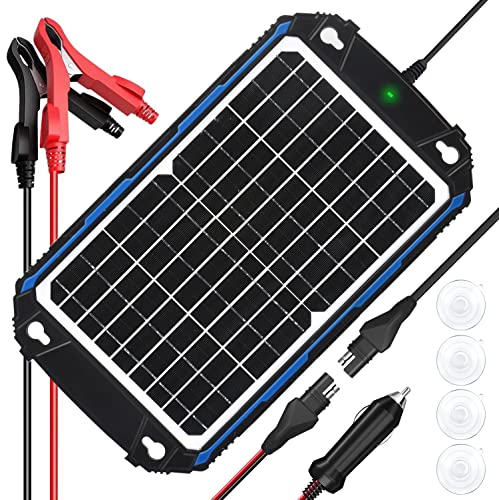
1. SUNER POWER Pro Solar Battery Charger & Maintainer
Best for: Maintaining parked 12V vehicle batteries
The SUNER POWER Pro is a 12-watt solar charger and maintainer for 12-volt batteries. It suits cars, boats, RVs, trailers, motorcycles, tractors, ATVs, and similar equipment that sits unused. The panel uses tempered solar glass, corrosion-resistant framing, and Grade A+ cells rated at 21% to 30% efficiency. Included suction cups and plug-and-play cables simplify temporary mounting.
Its built-in MPPT controller uses three charging stages: bulk, absorption, and float. The manufacturer rates tracking efficiency at up to 99% and conversion efficiency at up to 98%, though real output depends on sunlight, panel placement, and battery condition. The charger stops when the battery reaches full charge, then resumes after voltage drops. Safety features cover reverse polarity, short circuits, over-current, over-voltage, overcharging, over-discharging, overloads, and high temperature. It is listed for flooded, gel, AGM, SLA, maintenance-free, and LiFePO4 batteries. The 12-watt output fits maintenance duty better than fast battery recovery.
Pros
- Three-stage charging helps maintain 12V batteries without constant manual adjustment.
- Multiple electrical protections reduce risks from wiring mistakes and abnormal charging conditions.
- Tempered glass and a corrosion-resistant frame suit outdoor vehicle storage.
Cons
- Twelve watts will recharge a deeply depleted battery slowly, especially in weak sunlight.
- It needs direct, usable sunlight, so shaded parking or covered storage limits its output.
Buying Guide
Most important factor is panel wattage matched to the battery’s daily energy use. A 12-volt, 100Ah battery stores about 1,200Wh, but lead-acid models should usually use only 600Wh before recharging, so an undersized panel may need several sunny days.
- Panel wattage: For a 12V 100Ah lead-acid battery, choose about 150-200W for recovery in one sunny day with four peak-sun hours. A 50W panel suits smaller 20-40Ah batteries or slow maintenance charging.
- Charge controller: Choose an MPPT controller for larger arrays or cold climates. Its rating should exceed panel current by at least 25%, such as a 20A controller for a 15A panel.
- System voltage: Confirm the setup is 12V or 24V. A “12V” panel usually produces about 18-22V, which a proper controller must regulate before it reaches the battery.
- Battery chemistry: Verify compatibility with flooded, AGM, gel, or lithium batteries. LiFePO4 batteries need a controller with a lithium charging profile and low-temperature protection.
- Build and setup: Look for tempered glass, an IP65-rated controller, and cables at least 10 feet long if the battery stays indoors. Portable kits often cost $100-$250.
If you cannot have everything, prioritize correct wattage and controller compatibility, since those determine safe, useful charging.
Frequently Asked Questions
How many watts should a solar panel have for a deep-cycle battery?
A 100-watt solar panel suits a 12-volt, 100Ah deep-cycle battery for moderate daily charging, while a 200-watt setup works better after heavier use. Actual output depends on sunlight and losses. In strong sun, a 100-watt panel may produce roughly 25 to 35 amp-hours daily.
What type of solar controller works best with deep-cycle batteries?
An MPPT charge controller usually gives the best charging performance, especially when the panel voltage exceeds the battery voltage. Choose a controller rated above the array’s maximum current. For example, a 200-watt panel on a 12-volt system can reach about 17 amps, so a 20-amp controller fits.
Can a solar panel charge a deep-cycle battery without a controller?
No, a solar panel should not connect directly to a deep-cycle battery because voltage control can overcharge or damage it. Use a controller matched to the battery chemistry and system voltage. A 12-volt lead-acid battery typically needs a controller with a 12-volt setting and suitable charging stages.
Are portable solar panels good for charging deep-cycle batteries?
Yes, portable solar panels work well for smaller deep-cycle batteries, camping setups, and emergency charging, provided they include a compatible controller and enough wattage. A 100-watt folding panel can support a 12-volt, 50Ah battery, but cloudy weather may extend charging from one day to several.
Conclusion
SUNER POWER Pro Solar Battery Charger & Maintainer is the top choice for buyers who want a simple solar option for maintaining a deep-cycle battery between uses. If faster charging matters more than compact size, choose a higher-output panel from the roundup instead, since it can put more power into the battery during suitable sunlight. Before buying, double-check the panel’s physical size, battery compatibility, included quantity, and current price. Also confirm the setup fits your battery’s voltage and charging needs. A small maintainer may suit storage, seasonal equipment, or backup power. Larger systems make more sense for frequent use, bigger batteries, or areas with limited sunlight. Match the panel to your actual charging routine.