
6 Best Solar Battery Charger for RV for Off-Grid Trips
Voltset Solar Panel Battery Charger is the best solar battery charger for rv use for most buyers because it offers a simple way to keep a battery topped up from sunlight. Its panel-based design suits RV owners who want supplemental charging without adding a large power system or relying on shore power.
This guide is for campers, weekend travelers, and off-grid RV owners comparing portable battery maintainers and solar charging panels. The key factors are panel size, charging output, connector compatibility, and resistance to outdoor exposure. A larger panel may collect more energy, while a compact model fits better on crowded roofs or dashboards. Compatibility matters just as much, since battery type and connector design can limit your options. The six picks below are ranked with clear reasons and honest drawbacks for each.
Quick Comparison
| # | Product | Best For | Price | |
|---|---|---|---|---|
| 1 | Voltset Solar Panel Battery Charger | Best For Outdoor Vehicle Owners | $35.99 | View → |
| 2 | SUNER POWER PRO Solar Battery Charger & Maintainer | Best For Parked Car Maintenance | $99.95 | View → |
| 3 | SOLPERK 20W 12V Solar Panel Kit | Best For DIY 12V Setups | — | View → |
| 4 | SUNER POWER Pro Solar Battery Charger & Maintainer | Best For Marine Battery Upkeep | — | View → |
| 5 | SUNER POWER PRO Solar Battery Trickle Charger Keeper | Best For Long-Term Storage | — | View → |
| 6 | SUNER POWER PRO Solar Battery Charger & Maintainer | Best For RV Battery Care | $79.95 | View → |
6 Top Solar Chargers for RVs
These six RV solar chargers are ranked from sixth to first, counting down to our top pick.
6. SUNER POWER PRO Solar Battery Charger & Maintainer

Best for: Maintaining 12V vehicle batteries outdoors
This 30W solar charger maintains 12V batteries in cars, boats, RVs, trailers, trucks, and powersports equipment. Its built-in MPPT controller adjusts charging to make better use of available sunlight. The unit supports standard 12V, AGM, and lithium settings, including flooded, gel, SLA, VRLA, maintenance-free, and LiFePO4 batteries. At around $80, it costs more than a basic solar trickle charger.
The charging process uses three stages: bulk, absorption, and float. LEDs show approximate charge levels at 25%, 50%, 75%, and 100%. Once the battery reaches full charge, the system stops charging and resumes after the voltage drops. Safety features cover reverse polarity, short circuits, over-current, over-voltage, over-temperature, and overcharging. Waterproof construction, spark protection, suction-cup mounting, and plug-and-play cables simplify outdoor installation. Still, a 30W panel is better suited to maintenance than quickly charging a deeply drained battery.
Pros
- Three battery modes support standard 12V, AGM, and LiFePO4 batteries.
- Automatic three-stage charging helps maintain battery voltage without constant supervision.
- Waterproof housing, safety protections, and included suction cups suit outdoor vehicle use.
Cons
- The 30W output may charge slowly during cloudy weather or with a heavily discharged battery.
- It only supports 12V systems, so it cannot maintain 6V or 24V batteries.
5. SUNER POWER PRO Solar Battery Trickle Charger Keeper

Best for: Long-term storage of 12V vehicles
The SUNER POWER 20W solar charger maintains 12-volt batteries in cars, boats, RVs, trailers, motorcycles, tractors, and ATVs. Its built-in MPPT controller uses a three-stage cycle, bulk, absorption, and float, to replenish the battery and then maintain its charge. The panel uses tempered solar glass, Grade A+ cells, and a corrosion-resistant frame for outdoor use.
The charger stops when the battery reaches full charge and resumes after voltage drops. SUNER POWER lists protection against overcharging, over-discharge, short circuits, reverse polarity, overheating, and excessive current. The kit also supports flooded, gel, AGM, SLA, maintenance-free, and LiFePO4 batteries. Pre-drilled mounting holes, included screws, and plug-and-play cables simplify installation. Still, the 20W output suits battery maintenance more than fast charging. Its performance depends on direct sunlight, panel placement, and seasonal conditions.
Pros
- Three-stage charging helps maintain a 12V battery during storage.
- MPPT control can use available sunlight more effectively than basic controllers.
- Waterproof, spark-proof construction includes several electrical safety protections.
Cons
- A 20W panel charges slowly, especially after heavy battery drain or during cloudy weather.
- The kit needs a suitable outdoor mounting location with regular sun exposure.
4. SUNER POWER Pro Solar Battery Charger & Maintainer
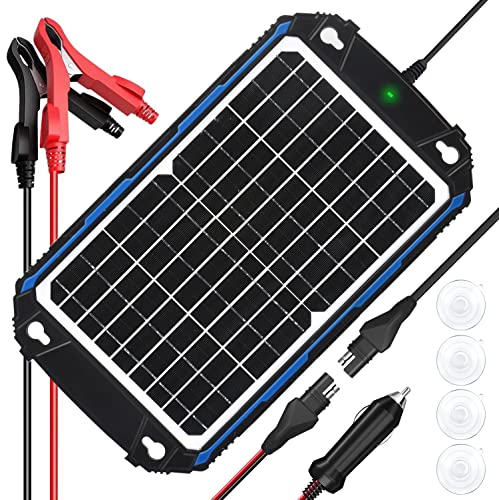
Best for: Maintaining parked 12V vehicles
SUNER POWER’s 12W solar panel is designed to keep a 12-volt battery topped up during storage. It fits cars, boats, RVs, trailers, motorcycles, tractors, ATVs, and other equipment with compatible batteries. The listed specifications support flooded, gel, AGM, SLA, maintenance-free, deep-cycle, and LiFePO4 lithium batteries. Plug-and-play cables and included suction cups make temporary mounting straightforward.
The built-in MPPT controller uses three charging stages: bulk, absorption, and float. This setup recharges the battery, then reduces charging as it fills. The unit stops at full charge and resumes after voltage drops. Safeguards cover reverse polarity, short circuits, over-current, over-voltage, overcharge, overload, over-discharge, and overheating. Tempered glass and a corrosion-resistant frame help it handle UV exposure, hail, and outdoor moisture. SUNER POWER claims up to 99% tracking efficiency and 98% peak conversion, but those figures have not been independently verified. The 12W output suits maintenance more than fast charging.
Pros
- Three-stage charging helps maintain battery health over long storage periods.
- Multiple electrical protections reduce risks from wiring and charging faults.
- Tempered glass and a corrosion-resistant frame suit outdoor vehicle storage.
Cons
- A 12W panel may take a long time to recharge a heavily depleted battery.
- Charging depends on direct sunlight, so cloudy weather and shaded parking reduce output.
3. SOLPERK 20W 12V Solar Panel Kit
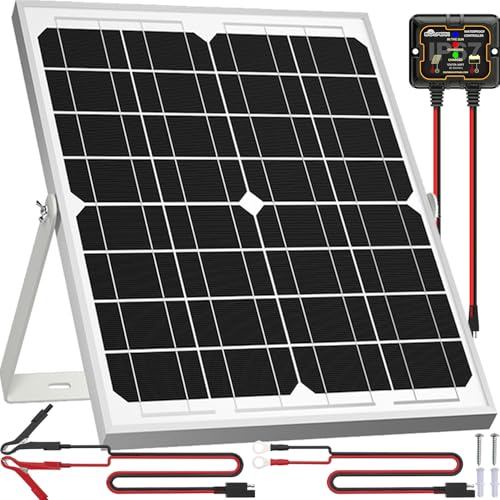
Best for: Parked 12V vehicles needing maintenance
The SOLPERK kit combines a 20W monocrystalline solar panel with an 8A smart controller for maintaining 12V rechargeable batteries. It supports LiFePO₄, lithium-ion, AGM, SLA, GEL, EFB, and MF batteries. The controller uses three-stage charging and has two indicator lights for checking charging status. It also includes alligator clips and O-rings for different battery connections.
The panel uses a low-iron tempered glass surface and an aluminum frame. SOLPERK rates it for outdoor use, with resistance to up to 2,400Pa of wind pressure and 5,400Pa of snow load. The manufacturer also claims a service life of up to 25 years, though real life depends on weather and installation. A 360-degree adjustable bracket helps aim the panel toward the sun. Pre-drilled holes, screws, and plug-and-play cables simplify setup. The kit includes the panel, controller, bracket, clips, O-rings, and mounting hardware.
Pros
- Supports several common 12V battery types, including LiFePO₄, AGM, SLA, GEL, and EFB.
- Three-stage charging helps limit overcharging, over-voltage, and short circuits.
- Adjustable 360-degree bracket allows more flexible sun positioning.
Cons
- At 20W, it is intended for trickle charging and battery maintenance, not quickly charging large batteries.
- The product listing does not provide panel dimensions, cable lengths, or a stated operating temperature range.
2. SUNER POWER PRO Solar Battery Charger & Maintainer

Best for: Maintaining 12V vehicle batteries outdoors
This 50W solar battery charger maintains 12V batteries in cars, boats, RVs, trailers, trucks, and powersports equipment. Its built-in MPPT controller adjusts charging for better solar energy use, while the three-stage cycle moves through bulk, absorption, and float charging. The unit costs around $100, so it sits above basic trickle chargers.
Three charging modes support standard 12V batteries, AGM batteries, and LiFePO4 lithium batteries. A front indicator shows 25%, 50%, 75%, or 100% charge levels, giving you a quick status check. The charger pauses at full charge and resumes after the battery drops. It also includes protection against overcharging, short circuits, reverse polarity, overheating, and other common faults. Waterproof construction, spark protection, suction cups, and plug-and-play cables simplify outdoor installation.
Pros
- MPPT control can improve solar power use compared with simpler controllers.
- Three-stage charging supports long-term battery maintenance.
- Four charge indicators make the battery status easy to read.
Cons
- The 50W panel depends on direct sunlight, so charging slows in cloudy weather, shade, or winter conditions.
- Suction-cup mounting may not hold well on dirty, textured, or highly curved surfaces.
1. Voltset Solar Panel Battery Charger
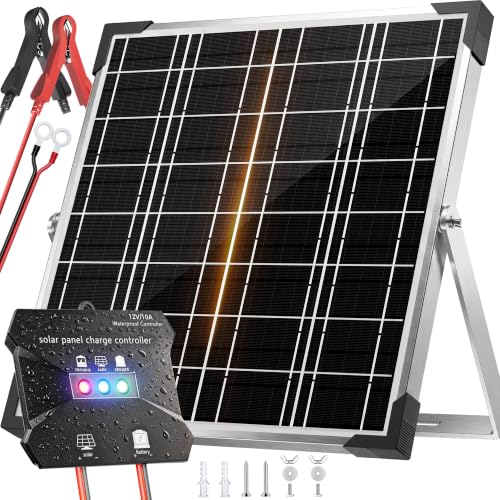
Best for: Maintaining parked 12V vehicles
The Voltset is a 20W solar panel and charge controller for keeping 12V batteries topped up during storage. Its monocrystalline panel uses MPPT tracking, which the manufacturer says can charge 20% to 30% faster than basic controllers in suitable sunlight. It fits cars, RVs, boats, trailers, and some off-grid setups. The system supports LiFePO4, AGM, gel, flooded, and lithium-ion batteries, giving it broader use than a lead-acid-only maintainer.
Protection against overcharging, over-discharging, short circuits, and reverse polarity helps reduce common wiring risks. The controller also stops nighttime drain and resumes charging when voltage falls. An IP67 rating and a stated operating range from -40°F to 185°F suit exposed outdoor mounting. The panel uses corrosion-resistant materials and carries a claimed lifespan of more than 25 years. Pre-drilled holes simplify installation, while LED indicators show charge levels from 25% to 100%. Still, charging speed depends heavily on sun exposure.
Pros
- Supports five 12V battery types, including LiFePO4 and AGM.
- MPPT control may improve charging speed in strong sunlight.
- IP67 protection and a wide temperature range suit outdoor use.
Cons
- A 20W panel can charge slowly during cloudy weather or heavy shade.
- The kit is limited to 12V systems, so it will not maintain 6V or 24V batteries.
Buying Guide
Battery compatibility is the most important factor. The charger must match your RV battery’s voltage and chemistry, or it may charge slowly, stop early, or cause damage.
- Battery voltage and chemistry: Match a 12-volt or 24-volt system, then select the correct profile for lead-acid, AGM, gel, or LiFePO4 batteries. Lithium batteries need a charger that supports lithium charging stages.
- Panel wattage: Size the panel to your battery bank and daily use. A 100-watt panel can provide roughly 25 to 35 amp-hours per sunny day, while a 200-watt setup suits larger banks or regular refrigerator use.
- Charge controller: Choose an MPPT controller when roof space is limited or temperatures vary widely. For a 100-watt panel, select a controller rated for at least 10 amps, with extra capacity for future expansion.
- Installation and portability: A fixed roof panel works for frequent camping, while a folding 100- to 200-watt kit stores more easily. Check cable length, mounting hardware, and whether the kit includes battery clamps.
- Weather protection and safety: Look for outdoor-rated panels, sealed connectors, reverse-polarity protection, and overcharge protection. A two-year warranty or longer offers useful coverage.
If you cannot have everything, prioritize battery compatibility and the correct charging profile.
Frequently Asked Questions
How many watts should an RV solar battery charger have?
An RV solar battery charger usually needs 100 to 400 watts, depending on battery size and daily power use. A 100-watt panel can maintain a small 12-volt battery, while a 300-watt setup better suits regular boondocking. Match the charger to a compatible controller and your battery’s chemistry.
What size solar charger do I need for an RV battery?
A 100Ah 12-volt RV battery typically pairs well with a 100- to 200-watt solar array for maintenance and moderate daily use. Choose closer to 200 watts if you run lights, fans, or a refrigerator regularly. Heavy inverter use may require more panels and additional battery capacity.
Can I use a solar charger while driving my RV?
You can use an RV solar charger while driving if the panels connect to the house battery through a properly sized charge controller. A 200-watt roof array can charge during travel, but shade, clouds, and panel angle reduce output. Confirm the wiring does not interfere with other charging systems.
Are MPPT chargers better than PWM models for RVs?
MPPT solar chargers usually collect more energy than PWM models, especially with higher-voltage panels or cooler weather. The gain often ranges from 10% to 30%, though results vary by setup. PWM controllers cost less and work well with smaller 12-volt systems where efficiency matters less.
Conclusion
Voltset Solar Panel Battery Charger is the top pick for RV owners who want a compact solar maintainer for keeping a battery ready between trips. If your priority is faster charging or support for a larger battery bank, choose a higher-output panel and controller instead. Before buying, double-check the charger’s physical size, battery compatibility, included connections, and whether you need one panel or several for your setup. Also compare the current price, since discounts and bundle options can change the value quickly. A solar charger helps reduce battery drain during storage, but it cannot replace a properly sized charging system for heavy daily power use. Choose the model that matches your battery and available mounting space.