
5 Best Faucet Water Filter for Hard Water Under Sinks
For most buyers, the PUR Plus Faucet-Mount Water Filtration System is the best faucet water filter for hard water because it offers certified reduction of several common contaminants in a compact, faucet-mounted design. Its quick-change filter and built-in indicator make routine replacements easier, while the direct connection keeps filtered water available at the sink without a countertop tank. This practical setup suits households that want cleaner-tasting water and less counter clutter.
This guide is for renters, families, and anyone who wants filtered water without installing an under-sink system. When comparing faucet-mounted purifiers, focus on filter life, replacement cost, faucet compatibility, and the unit’s size. Water flow also matters if you fill large bottles or cook often. The 5 picks below are ranked with clear reasons and honest drawbacks for each, so you can match the filter to your sink, budget, and water needs.
Quick Comparison
| # | Product | Best For | Price | |
|---|---|---|---|---|
| 1 | PUR Plus Faucet-Mount Water Filtration System | Renters needing faucet filtration | $29.99 | View → |
| 2 | Brita Elite Advanced Faucet Water Filter System | High-volume kitchen water users | $22.86 | View → |
| 3 | ICEPURE Under Sink Water Filter System | Under-sink installation planners | $47.49 | View → |
| 4 | CECEFIN 1080 Swivel Sink Filter | Small sinks needing swivel reach | $26.99 | View → |
| 5 | Aquabliss SF100 Shower Filter | Hard-water shower users | $36.99 | View → |
Our 5 Top Faucet Filters for Hard Water
These picks are ranked by filtration, flow rate, installation, and value, counting down to the top choice.
5. Aquabliss SF100 Shower Filter

Best for: Renters with dry, chlorine-sensitive skin
The Aquabliss SF100 is an inline shower filter with a chrome finish and a standard ½-inch connection. It fits fixed, rain, handheld, dual, and combo shower setups. The cartridge can face either direction, which makes installation less fussy. Thread seal tape comes in the box, and the maker says hand-tightening takes less than two minutes without tools.
Its filter is designed to reduce chlorine, odors, dirt, pesticides, and some pharmaceutical residue. It also aims to limit scale buildup, which may help hair and skin feel less dry in hard water. The cartridge should last about six months, with replacement costs advertised at under $0.09 per day. That schedule is convenient, but results can vary by water quality and usage. Claims about eczema, dandruff, nails, and major skin improvements should not replace medical care or independent water testing. At around $37, this is a moderate upfront purchase for a shower filter.
Pros
- Fits most standard ½-inch shower arms, including handheld and rain heads.
- Installs without tools, and replacement cartridges swap in either direction.
- Six-month cartridge life keeps maintenance less frequent than monthly replacements.
Cons
- It only fits standard shower connections, so unusual plumbing may need an adapter.
- The filter requires recurring cartridge purchases, and skin benefits are not guaranteed.
4. CECEFIN 1080 Swivel Sink Filter
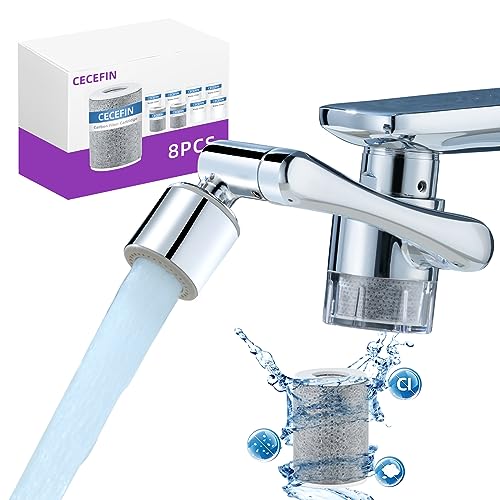
Best for: Small sinks needing flexible filtered water
The CECEFIN Sink Filter adds filtration and a foldable extender to a bathroom, kitchen, or laundry faucet. Its arm and ball joint rotate up to 1080 degrees, helping direct water toward a sink corner or your face. A rubber ring switches between a gentle bubble stream and a stronger spray. The maximum flow rate is 1.2 gallons per minute.
The package includes six white 1-micron cartridges and three carbon-fiber cartridges. The white filters target particles larger than 1 micron, while the carbon option helps reduce chlorine and odors. This system does not lower TDS or remove essential minerals. Brass connectors and an arm pair with a chrome-plated ABS aerator body. At around $27, it offers useful flexibility, but compatibility needs careful checking before purchase.
Pros
- The 1080-degree swivel and foldable arm make rinsing, face washing, and sink cleanup easier.
- Nine replacement cartridges are included, with six white filters and three carbon-fiber options.
- Two outlet modes support low-splash washing or faster rinsing at up to 1.2 GPM.
Cons
- It will not fit faucets with non-removable aerators, and other thread sizes need an adapter. Supported connections are female 55/64-inch and male 15/16-inch.
- Cartridge life can drop to one or two weeks with poor tap water. Carbon filters may also reduce water pressure.
3. ICEPURE Under Sink Water Filter System

Best for: High-volume municipal water users
The ICEPURE Under Sink Water Filter System connects to an existing cold-water faucet, so it does not require a separate countertop spout or drilled sink hole. It fits 1/2-inch or 3/8-inch female NPT connections and is designed for kitchens, RVs, offices, and bars. The system is rated for up to 2.5 gallons per minute at 60 PSI.
Its main advantage is the long replacement interval. With municipal water, the filter is rated for 22,000 gallons, or about three years, before replacement. A coconut-shell carbon block and 0.5-micron outer layer target chlorine, taste, odor, sediment, and certain heavy metals. NSF/ANSI 42 covers chlorine, taste, and odor reduction, while NSF/ANSI 372 addresses lead-free materials. The BPA-free, food-grade construction adds reassurance for drinking and cooking water. Installation uses a plug-and-play design, and the filter cartridge is designed to change in about two seconds. Still, buyers should confirm their plumbing connection before ordering.
Pros
- High capacity of up to 22,000 gallons, reducing replacement frequency.
- 2.5 GPM flow rate can support drinking, cooking, and coffee preparation.
- Direct-connect design avoids installing a second faucet or drilling the counter.
Cons
- It only works with cold-water lines and compatible 1/2-inch or 3/8-inch female NPT fittings.
- NSF/ANSI 42 focuses on chlorine, taste, and odor, so this is not a complete purifier for every contaminant.
2. Brita Elite Advanced Faucet Water Filter System

Best for: Standard-faucet households seeking cleaner water
The Brita Elite Advanced is a faucet-mounted water filter that delivers filtered water directly from your sink. Its carbon-block filter reduces chlorine taste and odor, plus more than 60 other contaminants. Brita says it reduces 99% of lead. That makes it a practical choice for drinking water, cooking, and filling bottles without using a countertop pitcher. The system costs under $25 and includes one filter.
Installation takes minutes and requires no tools, but the faucet must have standard threads. Pull-out and spray-style faucets are not compatible. A filter indicator shows when replacement is due, while three spray settings let you choose the water flow that fits the task. The housing is made without BPA. Brita also claims one filter can replace about 1,800 single-use plastic bottles over a year, though actual savings depend on household use and local water conditions.
Pros
- Provides filtered water directly from the tap, so there is no pitcher waiting period or refill step.
- Reduces chlorine taste and odor, 60-plus contaminants, and 99% of lead.
- Includes three spray options and a filter-change indicator for easier daily use.
Cons
- Fits standard faucets only, and will not work with pull-out or spray-style models.
- Includes just one filter, so replacement filters add an ongoing cost.
1. PUR Plus Faucet-Mount Water Filtration System

Best for: Renters seeking filtered tap water
This gray PUR Plus faucet-mount filter attaches to most standard faucets and provides filtered water at the sink. It uses a genuine PUR Plus replacement cartridge with 3-in-1 filtration, aimed at improving taste while reducing several unwanted tap-water contaminants. The setup costs about $30, which is a lower upfront cost than many countertop systems.
Its certifications give the product more substance than a basic taste filter. WQA certifies it to reduce lead, while NSF certification covers reductions in microplastics, chlorine, and 70 chemical and physical substances that may occur in tap or bottled water. Each cartridge lasts up to 3 months or 100 gallons, whichever comes first. A filter-change light shows when replacement time arrives. Installation takes minutes without tools, and the vertical design keeps the unit at the faucet. PUR estimates savings of up to $30 per week versus buying 16.9-ounce bottled water, though actual savings depend on local prices and water use.
Pros
- WQA certification covers lead reduction.
- Filter-change light signals when to replace the cartridge.
- Tool-free installation takes only a few minutes.
Cons
- It does not fit pull-out or handheld faucets.
- Replacement filters add an ongoing cost after 100 gallons or 3 months.
Buying Guide
Most important factor is whether the cartridge actually addresses hardness. Standard carbon faucet filters improve taste and chlorine levels, but they do not remove calcium or magnesium, so choose an ion-exchange model or use a separate softening system.
- Hardness reduction: Look for a stated reduction claim in grains per gallon (GPG) or milligrams per liter. Water above 7 GPG is hard, and a carbon-only filter is not enough for scale control.
- Certification: Prefer NSF/ANSI 42 for chlorine and taste, or NSF/ANSI 58 for reverse osmosis claims. Confirm the exact contaminant appears in the performance data, not just on the package front.
- Cartridge capacity: A rating near 100 to 200 gallons suits one person, while a family may need 300 gallons or more. Divide the rating by household use to estimate replacement timing.
- Faucet fit: Check compatibility with standard threaded faucets, usually 15/16-inch male or 55/64-inch female threads. These units often do not fit pull-out, pull-down, or spray faucets.
- Flow and cost: Aim for at least 0.5 gallons per minute and replacement cartridges costing about $10 to $30. Include an adapter if the faucet lacks standard threads.
If you cannot have everything, prioritize verified hardness reduction, since ordinary faucet filters will not prevent mineral scale.
Frequently Asked Questions
How do faucet filters handle hard water?
Most faucet-mounted filters do not remove hard-water minerals, so they cannot truly soften water. Look for a model with an ion-exchange or reverse-osmosis stage if hardness reduction matters. Standard carbon cartridges mainly target chlorine, odors, and sediment, not dissolved calcium and magnesium. For example, white crust around an aerator may remain.
What should I look for in a faucet filter for hard water?
Choose a faucet filter specifically rated for hardness reduction, because standard carbon cartridges mainly improve taste and odor. Check the package for calcium or magnesium claims, independent certification, and replacement-cartridge cost. For example, a filter that lists only chlorine reduction will not prevent white scale on a kettle or faucet aerator.
Can a faucet water filter remove calcium and magnesium?
A faucet water filter can remove calcium and magnesium only when it uses a suitable softening or membrane stage; most basic carbon models cannot. Check the performance label before buying, since “cleaner taste” does not mean softened water. For example, a cartridge may reduce chlorine while leaving hard-water minerals unchanged.
Are faucet-mounted filters better than water softeners for hard water?
Faucet-mounted filters are better for improving one tap’s drinking water, but a water softener is better for reducing hard-water scale throughout a home. A softener treats the supply before it reaches showers, sinks, and appliances. For example, one faucet cartridge cannot protect a 50-gallon water heater or multiple bathroom fixtures.
Conclusion
PUR Plus Faucet-Mount Water Filtration System is the top pick for renters and small households that want a simple, affordable way to improve tap-water taste without installing equipment. If your priority is reducing limescale rather than filtering chlorine or sediment, choose a true water-softening or scale-control system instead, because faucet cartridges typically do not remove hard-water minerals. Before buying, double-check the filter’s dimensions, your faucet’s compatibility, the number of replacement cartridges in the package, and the current price, since filter costs can change. Keep your expectations realistic: this type of filter can improve drinking water, but it will not protect every fixture or eliminate white scale across your home.