
6 Best Lightweight Solar Charger for Hiking
The BLAVOR Solar Power Bank is the best lightweight solar charger for most buyers. Its main advantage is a practical balance of packability and backup power, so it works for day hikes, travel, and emergency kits without taking much room. As a solar power bank, it can top up devices when an outlet is unavailable, though solar charging usually takes time and depends on strong sunlight. That makes its built-in battery more useful than relying on the panel alone.
This guide is for hikers, travelers, campers, and anyone building a small emergency kit. The key factors are total size, carry weight, battery capacity, charging ports, and how useful the solar panel is away from an outlet. The six picks below are ranked by their strengths, with clear reasons and honest drawbacks for each. Use the list to match a portable charger to your phone, trip length, and available sunlight.
Quick Comparison
| # | Product | Best For | Price | |
|---|---|---|---|---|
| 1 | BLAVOR Solar Power Bank | Campers Needing Emergency Backup | $29.99 | View → |
| 2 | SOARAISE Solar Power Bank | Hikers Wanting Phone Top-Ups | $59.99 | View → |
| 3 | Solar Power Bank | Budget-Conscious Outdoor Travelers | $29.99 | View → |
| 4 | BigBlue Solar Panel Charger | Backpackers Needing Foldable Charging | $59.97 | View → |
| 5 | Voltset Solar Panel Battery Charger | Motorcycle Riders Needing Battery Maintenance | $35.99 | View → |
| 6 | BLAVOR Solar Power Bank | Beach Trips With Phone Charging | $39.94 | View → |
6 Top Lightweight Solar Chargers
These compact solar chargers are ranked by weight, charging capacity, and useful features, counting down to the top pick.
6. BLAVOR Solar Power Bank
Best for: Camping trips and emergency kits
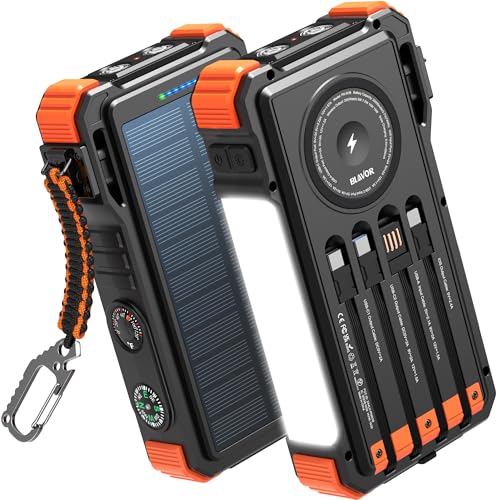
The BLAVOR Solar Power Bank packs a 20,000mAh battery into a rugged outdoor charger. It has four built-in cables, with two USB-C cables, one iOS cable, and one USB-A cable. Three ports add USB-C, USB-A, and iOS connections. Along with wired charging, a wireless pad supports compatible phones and Apple Watch models. The company says it can power up to six devices at once, though charging that many will slow the process.
Its USB-C port supports up to 20W, with a stated charge time of about 50 minutes for an iPhone 15. Claimed capacity estimates include roughly four iPhone 17 charges, 3.4 Galaxy S26 charges, or 37 Apple Watch 11 charges. Outdoor extras include a three-mode flashlight, three-level camping light, compass, thermometer, red indicator, carabiner, and rope. The ABS and PC shell, silicone protection, and safety circuits suit travel, outages, and basic emergency use. At around $40, it offers more utility than a plain battery pack, but the solar panel is best treated as a backup source.
Pros
- Four built-in cables reduce the need to pack charging cords.
- Wireless charging supports compatible phones and Apple Watch devices.
- Flashlight, camping light, compass, and thermometer add practical camp utility.
Cons
- Solar charging is typically slow and depends heavily on direct sunlight.
- Charging six devices at once can drain the battery quickly and reduce charging speed.
5. Voltset Solar Panel Battery Charger
Best for: 12V batteries stored outdoors
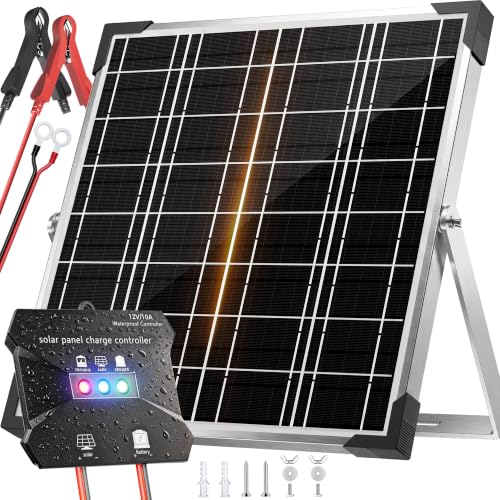
The Voltset is a 20W solar panel and charge controller for maintaining 12V batteries in cars, RVs, boats, trailers, and similar equipment. Its A+ monocrystalline panel feeds power through an MPPT controller, which the maker says can charge 20% to 30% faster than standard tracking systems. Around $36, it costs less than many larger solar kits, but its output remains modest.
The controller supports LiFePO4, AGM, gel, flooded, and lithium-ion batteries. Built-in protection covers overcharging, over-discharging, short circuits, and reverse polarity. It also stops nighttime power drain, then resumes charging when voltage falls. LED indicators show levels from 25% to 100%. The IP67 rating and claimed operating range of -40°F to 185°F suit outdoor storage. Voltset also claims a lifespan of more than 25 years, though real service life will depend on weather, mounting, and battery use. Pre-drilled holes simplify installation, but sunlight still controls charging speed.
Pros
- Supports several 12V battery types, including AGM, gel, flooded, and LiFePO4.
- Protective controls reduce risks from reverse polarity, short circuits, and overcharging.
- IP67 weather resistance fits boats, campers, trailers, and outdoor battery boxes.
Cons
- A 20W panel may charge large or deeply drained batteries slowly, especially in cloudy weather.
- It maintains batteries best, but may not provide enough power for frequent vehicle use or heavy electrical loads.
4. BigBlue Solar Panel Charger

Best for: Campers needing direct solar charging
The BigBlue 28W foldable solar charger uses N-type cells and a front surface without metal lines, which helps it collect more light across the panel. Its rated conversion efficiency reaches 25.4%, and the heat-resistant design should handle regular outdoor use better than basic fabric chargers. The panel folds to 11 x 6 x 1.4 inches and weighs 1.5 pounds, making it practical for a backpack or emergency kit. It costs around $60.
Three ports sit on the charging panel: two USB-C and one USB-A. Each port can reach 5V/3A, while the combined output is rated at 5V/4.8A. That allows charging several small devices at once when sunlight is strong. The panel does not include a battery, so it must stay connected to a device or power bank in direct sun. Output will drop with clouds, poor positioning, heat, or shade. The IP44 panel surface resists rain and wear, but the USB junction box is not waterproof. A 50cm USB-C cable and carabiners come in the package.
Pros
- Three charging ports support phones, GPS units, flashlights, and power banks.
- Folding dimensions and 1.5-pound weight suit camping and emergency storage.
- N-type cells and 25.4% rated efficiency can improve low-light performance.
Cons
- It cannot store electricity, so charging stops when sunlight fades or the panel disconnects.
- It cannot provide enough power for laptops or large power stations.
3. Solar Power Bank

Best for: Multi-device emergency kits
This portable charger uses a 20,000mAh lithium-polymer battery for travel, outages, and group trips. The listing says it can charge an iPhone 17 more than four times, an iPad Pro one to two times, or a Galaxy phone multiple times. It supports up to five devices at once through two USB-A ports, a USB-C port, and three built-in cables for USB-C, Lightning, and USB-A connections. The price is around $30.
Four folding solar panels give this power bank more sunlight-collecting surface than single-panel designs. Solar charging still depends on strong, direct sunlight, so wired charging through USB-C or USB-A remains the practical choice when you need power quickly. An IP67 rating protects against dust and temporary water exposure, while over-current, over-voltage, and temperature controls protect connected devices. The lighting setup includes a dual flashlight with steady, SOS, and strobe modes, plus a three-level camping light. Only one lighting system can run at a time.
Pros
- Charges up to five devices from built-in cables and ports.
- Four solar panels offer a useful backup charging option outdoors.
- IP67 protection and emergency lighting suit camping and power outages.
Cons
- Solar charging is weather-dependent and less predictable than wired charging.
- The listing gives conflicting warranty details, stating both 24 and 36 months.
2. SOARAISE Solar Power Bank

Best for: Long outdoor trips and emergencies
The SOARAISE is a high-capacity portable charger with a 48,000mAh lithium-polymer battery. Four solar panels sit on the unit, allowing it to recharge from sunlight without a wall outlet. Its 5V/3A USB-C port supports faster wired charging, with the stated ability to move an iPhone from 15% to 60% in 30 minutes. At around $60, it targets campers, travelers, and emergency kits.
This power bank supports up to seven devices at once through two USB-A outputs, one USB-C input/output port, four built-in cables, and a wireless charging pad. The cables include USB-C, phone, USB-A, and Micro connectors, so carrying separate cords becomes less necessary. Wireless charging works with many recent iPhone and Samsung Galaxy models, but the phone must stay aligned on the pad. The four-panel design is more useful outdoors than a single small panel, although solar recharge speed still depends on direct sunlight and weather.
Pros
- 48,000mAh capacity suits multi-day trips and power outages.
- Four built-in cables reduce the need for extra charging cords.
- Wireless pad and three ports allow charging several devices together.
Cons
- Solar charging can remain slow in cloudy weather or indirect sunlight.
- Wireless charging is usually less efficient than the wired 3A connection.
1. BLAVOR Solar Power Bank
Best for: Day hikes and emergency kits
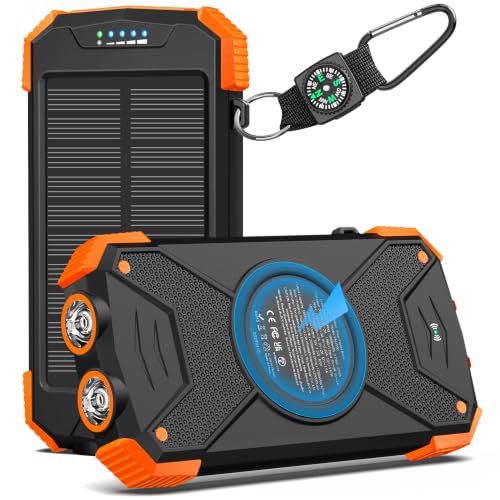
The BLAVOR Solar Power Bank stores 10,000mAh for phones, tablets, and other small devices. It supports wireless charging plus USB-C input and output, with up to 20W wired charging. BLAVOR says it can charge an iPhone 15 to 65% in 30 minutes under compatible conditions. You can charge up to three devices at once, although sharing power may reduce charging speed. At around $30, it offers several charging options in one compact unit.
Its lithium-cobalt battery is rated for about 50% more cycles than a typical lithium-polymer battery, according to the brand. The case combines flame-retardant ABS and PC plastic with a silicone waterproof layer. An IPX5 rating helps protect against water spray, dust, and light impacts. Two bright flashlights, a compass, and a carabiner add useful features for camping or roadside emergencies. The solar function can provide a backup top-up in sunlight, but the small panel will not replace USB charging for quickly refilling 10,000mAh.
Pros
- 20W USB-C output supports faster wired charging for compatible phones.
- Wireless charging and multiple ports allow up to three devices at once.
- IPX5 protection, dual flashlights, a compass, and a carabiner suit outdoor use.
Cons
- Solar charging is slow and works only with strong, direct sunlight.
- Wireless charging is less efficient than a cable and may not work through thick phone cases.
Buying Guide
The most important factor is usable charging power in direct sunlight. A compact panel may weigh little, yet produce too little energy to refill a phone before nightfall.
- Panel output: Choose at least 10 watts for phones and small cameras, or 20 to 28 watts for faster charging and two devices. Expect slower results in clouds, shade, or winter sun.
- Weight and packed size: Stay under 1.5 pounds for day hikes. A folded panel around 6 by 10 inches fits more easily in a small pack than a larger, rigid model.
- Battery capacity: If the unit includes a power bank, look for 10,000 to 20,000mAh. That range can provide roughly two to four phone charges, depending on the phone and energy loss.
- Ports and compatibility: USB-C input and output give the most flexibility. At least one 18W USB-C port is useful for newer phones, while two ports help charge separate devices.
- Weather protection and price: Look for water resistance rated IPX4 or higher, reinforced cable points, and a price between $35 and $120. Avoid paying extra for built-in lights unless you need them.
If you cannot have everything, prioritize panel output, since a lighter unit that charges too slowly may be less useful than a slightly heavier one.
Frequently Asked Questions
How do lightweight solar chargers work?
Lightweight solar chargers turn sunlight into electricity with photovoltaic cells, then send that power to a device or store it in a built-in battery. Output depends on panel size and sun exposure. A compact 5-watt panel may charge slowly, while larger 10-watt models can provide more useful daytime power.
What features should I look for in a lightweight solar charger?
A good lightweight solar charger should have enough wattage for your devices, a durable panel, protected ports, and a weight you can carry comfortably. Check USB-C support, battery capacity, and water resistance before buying. For backpacking, a unit under 1 pound is easier to pack than heavier power stations.
Can a lightweight solar charger charge a phone on cloudy days?
Yes, a lightweight solar charger can charge a phone in cloudy weather, but the panel usually produces less power and takes longer. Keep it outdoors with an unobstructed sky, and expect charging speed to vary. A phone that needs two hours in strong sun may require four hours or more under clouds.
Are lightweight solar power banks worth taking hiking?
Lightweight solar power banks are worth taking hiking when you need backup power and can accept slow solar charging. They work best for topping up phones between uses, not for quickly refilling large batteries. A 10,000mAh bank can add useful reserve power, but its panel may need a full sunny day.
Conclusion
BLAVOR Solar Power Bank is the top pick for hikers, travelers, and emergency-kit owners who want a compact backup battery with solar charging when outlets are out of reach. If your priority is faster solar charging rather than pocket-sized backup power, choose a larger foldable solar panel paired with a compatible power bank, since its broader surface can capture more sunlight. Before buying, double-check the charger’s folded and unfolded size, device compatibility, quantity included in the package, and current price, since listings and bundles can change. Also review the charging ports, battery capacity, water-resistance rating, and warranty terms. Solar input works best in strong, direct light, so treat it as a backup feature instead of your only power source.