
7 Best Backpacking Solar Charger for Long Hikes
BigBlue Solar Panel Charger is the top pick for most buyers. It takes the best backpacking solar charger spot because it balances a packable design with useful charging capacity, giving hikers a practical way to top up phones and small USB devices away from outlets.
This guide is for backpackers, campers, and emergency-kit shoppers who need extra power without carrying a large battery station. For solar charging panels, the two details that matter most are packed size and weight, plus how much power the panel can deliver in changing sunlight. A light charger that takes too long to refill a phone may save space but create frustration. The seven picks below are ranked by their strengths, with clear reasons and honest drawbacks for each, so you can match a panel to your trip length, device needs, and available daylight.
Quick Comparison
| # | Product | Best For | Price | |
|---|---|---|---|---|
| 1 | BigBlue Solar Panel Charger | Backpackers needing compact charging | $59.97 | View → |
| 2 | BigBlue 35W Solar Charger | Campers powering multiple devices | $89.99 | View → |
| 3 | FlexSolar 40W Foldable Solar Panel Charger | Hikers wanting foldable panels | $53.98 | View → |
| 4 | BLAVOR Solar Power Bank Wireless Charger | Emergency kits needing wireless backup | $29.99 | View → |
| 5 | FlexSolar 25W Portable Solar Panel Charger | Day hikers packing lighter gear | $31.99 | View → |
| 6 | ELECOM NESTOUT Portable Solar Panel | NESTOUT gear ecosystem users | $129.99 | View → |
| 7 | GEYOTO Solar Panel Charger | Budget-conscious outdoor phone users | $59.99 | View → |
7 Top Solar Chargers for Backpacking
The list is ranked from seventh place down to the top pick, with each charger matched to a different trail priority.
7. GEYOTO Solar Panel Charger

Best for: Backpackers needing daytime USB power
This GEYOTO folding solar charger provides up to 45W for phones, tablets, power banks, and other USB devices. Its monocrystalline cells claim up to 25.4% conversion efficiency in direct sunlight. The USB-C port supports 25W PD charging, while two USB-C ports and one USB-A port can power up to three devices at once. At around $60, it costs more than basic phone-sized solar panels, but offers broader device support.
The panel weighs 1.65 pounds and folds to 8.44 by 12.52 by 1.26 inches, close to an iPad’s footprint. A laminated surface gives it an IP68 water and dust resistance rating, though the charging ports still need to stay dry. The package includes a USB-C extension cable, storage pouch, two carabiners, and a manual. A two-year warranty adds useful coverage. Solar output will change with clouds, panel angle, obstructions, and the connected device, so pairing it with a power bank makes the most sense for longer trips.
Pros
- 25W USB-C PD output can charge compatible phones and tablets directly.
- Three ports support charging several USB devices from one panel.
- Folded size, 1.65-pound weight, pouch, and carabiners suit backpack travel.
Cons
- Solar charging slows sharply in clouds, shade, poor angles, or weak sunlight.
- The 45W rating is not a guaranteed constant output, especially with multiple devices connected.
6. ELECOM NESTOUT Portable Solar Panel

Best for: Sunny camping and emergency charging
The ELECOM NESTOUT is a foldable, four-panel solar charger rated for up to 28W of power. It has two USB-A ports for phones, tablets, earbuds, and other compatible devices. The panels use SunPower MAXEON cells, which ELECOM says can provide up to 24% greater efficiency than traditional solar cells. Around $130, it costs more than basic folding solar chargers, but the design includes useful outdoor details.
A built-in LED current checker shows power reaching the USB ports, so you can see whether the panels are producing energy. Two adjustable stands help aim the charger toward the sun. The ripstop nylon case resists water, while two mesh pockets hold cables or small gear. Three exterior loops let you hang the charger from a tent, tree, or cord. It also folds for transport and received an iF Design Gold Award. The main limitation is its USB-A output. Newer USB-C devices may need an adapter or a separate cable.
Pros
- Four panels provide up to 28W of solar charging capacity.
- Adjustable stands help position the panels toward direct sunlight.
- Ripstop nylon, mesh pockets, and three hanging loops suit outdoor use.
Cons
- Dual USB-A ports are less convenient for newer USB-C devices.
- Solar output drops in clouds, shade, and poor sun angles.
5. FlexSolar 25W Portable Solar Panel Charger

Best for: Backpacking with small devices
The FlexSolar 25W is a folding solar charger for phones, lights, GPS units, and other USB devices. It weighs 1.2 pounds and folds to a listed 7.7 by 5.1 footprint, so it can ride on a pack without taking much room. Two carabiners and a fixed elastic strap are included. The panel has both USB-A and USB-C ports, with a rated 5V/3A output for charging two devices at once.
Its strongest feature is the layered construction. A scratch-resistant E-film coating, UV-stabilized EVA, and impact-absorbing polymer backing protect the solar cells. The maker rates the panel for more than 2,000 fold cycles and claims 23.2% photovoltaic efficiency. MPPT power management may help during uneven sunlight, but charging speed still depends heavily on clear, direct sun. IP67-rated components are designed to handle dust and temporary immersion up to 1 meter for 30 minutes. Around $32, it offers useful weather protection, though it does not store power by itself.
Pros
- USB-A and USB-C ports support charging two devices from one panel.
- Folding design, two carabiners, and a strap simplify pack or tent attachment.
- IP67-rated components resist dust, rain, and brief water immersion.
Cons
- Solar output drops sharply in clouds, shade, and late-day sunlight.
- No built-in battery is included, and charging cables are not listed among the contents.
4. BLAVOR Solar Power Bank Wireless Charger
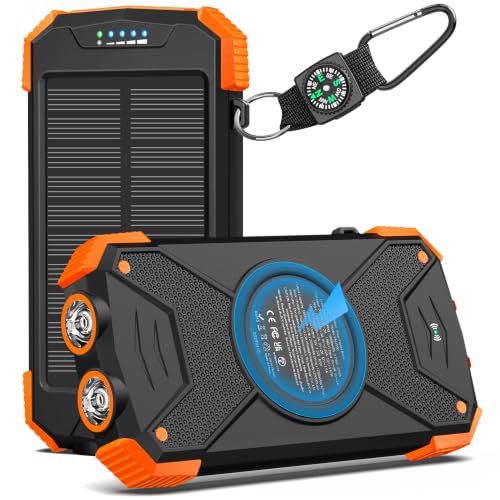
Best for: day hikes and power outages
The BLAVOR Solar Power Bank is a 10,000mAh backup battery for phones, tablets, and other USB devices. It supports USB-C input and output, plus wireless charging for compatible phones. The USB-C port reaches up to 20W, and BLAVOR claims it can charge an iPhone 15 to 65% in 30 minutes. It can power three devices at once through its various charging options.
Its lithium-cobalt battery is designed for more recharge cycles than a standard lithium-polymer cell. A full charge is rated for about 3.6 iPhone 8 charges, 2.2 iPhone 14 Pro charges, or one iPad Air charge. The flame-retardant ABS and PC shell has a silicone seal and an IPX5 water-resistance rating. Two bright flashlights, a compass, and a carabiner make it useful outdoors. At around $30, it offers more backup features than a basic battery pack.
Pros
- 20W USB-C output supports faster charging for compatible phones.
- Wireless charging and wired ports can power three devices simultaneously.
- IPX5 protection, two flashlights, a compass, and a carabiner suit outdoor use.
Cons
- Solar charging is best treated as an emergency top-up, not the primary way to refill the battery.
- IPX5 protection handles water splashes, but the power bank should not be submerged.
3. FlexSolar 40W Foldable Solar Panel Charger

Best for: Backpacking, emergency kits, and camps
The FlexSolar 40W is a foldable solar charger for phones, tablets, power banks, and small power stations. It has one USB-A QC3.0 port and one USB-C PD2.0 port, each rated up to 18W. A 19V DC output can deliver up to 40W to compatible equipment. This panel creates power but does not store it, so you need direct sunlight or a separate battery.
The four-panel design folds to 8.0 by 11.1 by 1.8 inches and weighs 1.76 pounds. That size fits many backpacks and emergency storage bins. Monocrystalline cells provide a stated 24% conversion rate, while the ETFE surface resists abrasion better than basic plastic coatings. The panel carries an IP67 dust and water rating, though its junction box is not fully waterproof. Two carabiners and a user manual are included. An LED indicates charging, and built-in protection helps guard against excess current, heat, and short circuits.
Pros
- USB-C and USB-A outputs can charge two devices at once, with up to 18W per port.
- The 40W DC port can power compatible small power stations directly.
- At 1.76 pounds, the folded panel suits backpacking and emergency storage.
Cons
- Using multiple ports divides available power, so single-port charging works better when sunlight is limited.
- Shade can reduce output by up to 70%, and the junction box should stay indoors during heavy rain.
2. BigBlue 35W Solar Charger

Best for: Backpackers needing daytime USB charging
The BigBlue 35W is a foldable solar charger for phones, tablets, cameras, GPS units, and power banks. It has two USB-C ports and one USB-A port. USB-C1 provides up to 25W with PD and PPS, while USB-A supports QC 18W. USB-C1 does not support Apple devices. Folded, the panel measures 8.29 × 4.84 × 1.89 inches and weighs 1.54 pounds, so it fits most daypacks without taking much room.
Its 25.4% efficient monocrystalline cells and dual parallel circuit design help maintain output when part of the panel falls into shade. The panel also carries IP68 protection against dust and water, which suits camping, hiking, RV travel, and emergency kits. At around $90, it costs more than basic solar panels. It also does not store power, so it only charges in direct sunlight. Keep connected devices shaded, since heat can slow or stop charging. The USB connection box is not waterproof.
Pros
- Three charging ports support phones, tablets, cameras, GPS units, and power banks.
- USB-C1 offers 25W PD and PPS charging for compatible devices.
- Foldable 1.54-pound design fits backpacking and travel kits.
Cons
- USB-C1 cannot charge Apple devices, limiting its usefulness for some iPhone and iPad owners.
- It has no built-in battery and needs direct sunlight, while the USB junction box must stay dry.
1. BigBlue Solar Panel Charger

Best for: Campers building emergency charging kits
The BigBlue 28W solar charger folds down to 11 x 6 x 1.4 inches and weighs 1.5 pounds. Its three ports include two USB-C connections and one USB-A port. Each can reach 5V/3A, with a combined maximum of 5V/4.8A. That setup can charge several smaller devices at once, including phones, GPS units, flashlights, and power banks. The package includes a 50cm USB-C to USB-C cable and carabiners. At around $60, it costs more than basic single-port panels but offers more connection options.
Its front surface has no metal lines, while N-type cells help maintain performance in weaker light. The panel converts up to 25.4% of sunlight and has an IP44-rated surface that resists rain, fog, and wear. A blue LED shows when charging is active. The panel cannot store power, so it must stay connected to a device or power bank in direct sunlight. Output changes with cloud cover, panel angle, heat, and the connected device. Keep phones in the shade to prevent thermal slowdowns.
Pros
- Three USB ports support simultaneous charging for multiple small devices.
- Folded size and 1.5-pound weight fit camping bags and emergency kits.
- N-type cells and a 25.4% rated conversion efficiency support charging in variable light.
Cons
- It has no internal battery, so charging stops when sunlight fades or conditions worsen.
- The USB junction box is not waterproof, and the panel cannot power laptops or large power stations.
Buying Guide
The most important factor is usable solar output, not peak wattage. Shade, clouds, and poor panel angles can make a 10-watt panel produce far less power than its label suggests.
- Panel output: Choose 10 to 20 watts for phones, GPS units, and small cameras. A 5-watt model works for emergency top-ups but may need several sunny hours per device.
- Battery capacity: Select 10,000 mAh for roughly one to two phone charges. Choose 20,000 mAh for longer trips, but expect extra weight and slower solar recharging.
- Weight and packed size: Keep the charger under 1.5 pounds for most backpacking loads. A folded panel near 10 by 7 inches fits more easily into an exterior pack pocket.
- Weather resistance: Look for at least IPX4 protection against rain and splashes. Keep non-submersible units out of puddles, and cover exposed ports during storms.
- Ports and charging: USB-C input and output provide more flexibility than USB-A alone. Two ports help charge a phone and headlamp, while a 2.4-amp output suits common mobile devices.
If you cannot have everything, prioritize reliable solar output at a weight you can carry for the entire trip.
Frequently Asked Questions
How do I choose a solar charger for backpacking?
Choose a backpacking solar charger by comparing its packed size, weight, panel output, battery capacity, and weather resistance. A 10-watt panel may suit weekend trips, while longer routes benefit from a 20-watt panel paired with a 10,000 mAh battery. Look for foldable panels under roughly 2 pounds if pack space is limited.
What size solar charger do I need for backpacking?
Most backpackers need a 10 to 20-watt solar panel, with a 5,000 to 10,000 mAh battery for phones and small devices. A compact 10-watt model saves weight but charges slowly in weak sun. A 20-watt folding unit takes more room, yet it gives you better charging flexibility at camp.
Can solar chargers work in cloudy weather?
Yes, solar chargers can produce power in cloudy weather, but charging usually takes longer and may be weaker. Thin clouds may reduce output substantially, so a phone that needs two hours in strong sun could take four hours or more. Keep the panel uncovered and use a battery bank to store power during brighter periods.
Do solar power banks work for long backpacking trips?
Yes, solar power banks can help on long backpacking trips, but they should supplement, not replace, a full battery or other charging plan. Their small built-in panels often recharge slowly, especially inside a pack or under tree cover. A 10,000 mAh bank can provide useful phone backup, while a separate folding panel collects energy more effectively at camp.
Conclusion
BigBlue Solar Panel Charger is the top recommendation for backpackers who want a practical way to recharge USB devices during multi-day trips. If your priority is carrying less weight, choose a smaller foldable panel instead, even if it gathers power more slowly. Before buying, double-check the packed size, device and cable compatibility, the number of panels or charging ports included, and the current price, since listings can change. Solar charging works best when the panel has clear sun and time to work, so it should support, not replace, a charged power bank. For most hikers, the right choice balances usable charging space with pack weight, setup time, and the devices you need to keep running.